



The Great Rift in the Sky
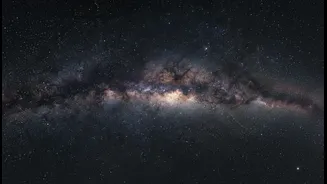
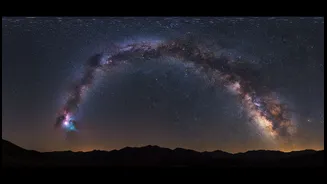
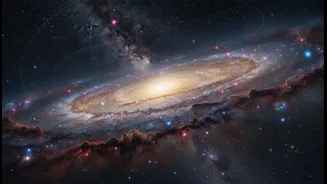
On a clear, dark night, the Milky Way arcs across the sky like a celestial highway. Running through its brightest section is a dark, patchy lane known as the Great Rift. This isn't an absence of stars, but rather a colossal curtain of interstellar dust
blocking the light from stars behind it. This dust lane is part of our galaxy's disk, the flat, spinning structure where our solar system resides. The disk contains most of the galaxy's young, hot stars, along with the gas and dust needed to form new ones. While beautiful and immense, this dusty disk is just one component of a much larger, multi-layered galactic city with a complex history and an invisible skeleton.
The Ancient, Crowded Core
At the heart of our galaxy lies the central bulge, a tightly packed, roughly spherical collection of stars. Unlike the flat disk, the bulge is a three-dimensional hub populated mainly by older, redder stars. Think of it as the galaxy's old town, where the first generations of stars settled. These stars follow more random, disordered orbits compared to the orderly rotation of stars in the disk. Studies suggest that most of the stars in this central region formed in a massive burst more than 10 billion years ago. Deep within this stellar metropolis, hidden by gas and dust, lurks Sagittarius A*, the supermassive black hole around which the entire galaxy revolves.
A Ghostly Sphere of Old-Timers
Surrounding the entire visible disk and bulge is a vast, nearly spherical structure called the stellar halo. This region is incredibly sparse, containing only about one percent of the galaxy's stellar mass, but it extends far beyond the main disk. Its residents are among the most ancient in the Milky Way, including old, individual stars and about 150 globular clusters. Globular clusters are dense, spherical swarms of hundreds of thousands to millions of stars that are over 10 billion years old. These clusters and field stars in the halo are like celestial fossils, providing clues about the galaxy's earliest formation stages, as many are remnants of smaller galaxies that the Milky Way absorbed over cosmic time.
The Unseen Scaffolding
The biggest piece of the puzzle, however, is one we cannot see at all: the dark matter halo. This is the true 'larger story' of the galaxy. All the stars and gas we can observe are just the decorative lights on an enormous, invisible structure. Scientists know this halo exists because of its gravitational effects. The stars on the outer edges of our galaxy are moving far too fast; without the gravitational pull of a massive, unseen halo, they would fly off into intergalactic space. This dark matter halo is thought to be a massive, clumpy sphere that envelops everything else, accounting for the vast majority of our galaxy's total mass. Its gravity dictates the galaxy's structure and rotation, acting as the fundamental scaffolding upon which our visible galaxy is built.
A Cosmic Recycling System
The Milky Way is not a static object but a dynamic, living system. It actively recycles material in a process sometimes called a 'galactic fountain.' Supernova explosions and powerful stellar winds from massive stars blast gas and heavy elements out of the galactic disk, high into the halo. This material cools and forms clouds that eventually rain back down onto the disk, seeding the next generation of stars and planets with enriched materials. This cosmic recycling is a vital engine for star formation, ensuring that our galaxy continues to evolve. It’s a messy, beautiful, and perpetual process of death and rebirth on a galactic scale.