




How do you find an object that is completely invisible? That is the challenge facing astronomers hunting for black holes. But a new generation of 'black hole hunters' has a clever solution: watch the stars, not for the holes themselves.
The Galaxy's Invisible Population
Our Milky Way galaxy
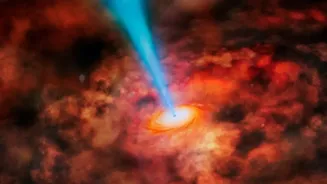
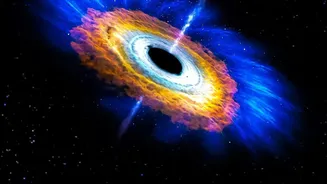
is a busy place, teeming with hundreds of billions of stars. But it's also home to a vast, unseen population of stellar ghosts. Scientific models predict there could be as many as 100 million stellar-mass black holes lurking in the dark. These are the remnants of massive stars that collapsed under their own gravity. The problem is that, unless a black hole is actively feeding on a nearby star, creating a bright disc of superheated material, it emits no light of its own. This makes the vast majority—those that drift through the galaxy alone—effectively invisible and incredibly difficult to count. For decades, astronomers have only been able to find a few dozen, mostly in binary systems where their presence could be inferred from their companion star's behaviour. This has left a huge gap in our understanding of our own cosmic neighbourhood.
Light as a Cosmic Magnifying Glass
To find these solitary wanderers, astronomers are turning to a mind-bending phenomenon predicted by Albert Einstein over a century ago: gravitational microlensing. According to his theory of general relativity, massive objects warp the fabric of spacetime. This warping acts like a lens, bending and magnifying the light from any object that passes behind it from our point of view. When a black hole passes almost perfectly in front of a distant star, its intense gravity focuses the starlight, causing the star to appear to brighten significantly for a period of weeks or months before fading back to normal. This temporary brightening is a tell-tale clue that a massive, dark object has passed by. This technique, called photometric microlensing, allows astronomers to 'see' the invisible by observing its effect on the visible.
More Than Just a Flicker of Light
However, a change in brightness alone isn't definitive proof of a black hole. A faint, slow-moving star could potentially mimic the same effect. To be certain, the new black hole hunters add a second, crucial measurement: astrometry. Astrometry is the science of measuring the precise position and motion of stars. As the black hole's gravity magnifies the background star's light, it also causes a tiny, temporary shift in the star's apparent position in the sky. By combining the measurement of the brightness change (photometry) with the measurement of the position shift (astrometry), scientists can break the ambiguity. This two-pronged approach allows them to calculate the mass and distance of the lensing object with remarkable precision. If the object is massive enough to be a black hole but gives off no light of its own, they've found their ghost.
The Tools of the Hunt
This advanced form of cosmic detective work is made possible by incredibly powerful observatories. Ground-based surveys like the Optical Gravitational Lensing Experiment (OGLE) constantly monitor millions of stars, looking for the initial brightening events that might signal a microlensing black hole. Then, high_precision instruments like the Hubble Space Telescope, and in the future, NASA's Nancy Grace Roman Space Telescope, can perform the follow_up astrometric measurements needed for confirmation. The European Space Agency's Gaia mission, which is creating an ultra_precise 3D map of our galaxy, is also a game_changer, capable of spotting the tell_tale 'wobble' of a star being tugged by an unseen black hole companion. The Roman Telescope, set to launch around 2026, is particularly anticipated as it will conduct vast microlensing surveys, promising to find hundreds, if not thousands, of these hidden objects.
Building a Black Hole Census
Each new discovery is more than just bagging another cosmic trophy; it's about building a complete census of the galaxy. By finding and weighing these isolated black holes, scientists can test their theories about how massive stars live and die. How many black holes are there really? What is the typical mass? Are they distributed differently throughout the galaxy? Answering these questions will fill in crucial details about the evolution of the Milky Way. This new search method provides the first real opportunity to find the missing majority of black holes, moving them from the realm of theory into the logbooks of observed astronomical objects. It's a quiet, patient hunt, relying on any subtle gravitational whispers that give away any galaxy's darkest secrets.