






A Mission Beyond its Mandate
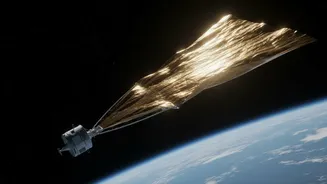
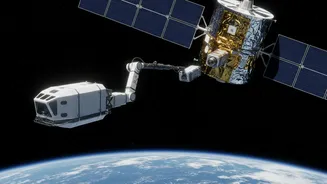
The Hayabusa2 spacecraft, operated by the Japan Aerospace Exploration Agency (JAXA), had a clear and ambitious goal: travel to the near-Earth asteroid Ryugu, collect samples, and return them to Earth. It executed this mission flawlessly. Launched in 2014,
it rendezvoused with Ryugu in 2018, performed daring touchdowns to collect surface and subsurface materials, and successfully dropped its precious cargo in the Australian desert in December 2020. For most missions, this would be the triumphant end. But for Hayabusa2, it was just the beginning of a new chapter. Thanks to some clever, forward-thinking engineering, the spacecraft was still healthy and had fuel to spare, prompting JAXA to approve an extended mission.
Engineering for the Unknown
The ability to extend Hayabusa2's life wasn't a lucky accident; it was the direct result of deliberate design choices made years earlier. A key factor was its propulsion system. The spacecraft is equipped with highly efficient ion engines, which use xenon propellant. While powerful, they are incredibly frugal. After its primary six-year mission, Hayabusa2 still had roughly half of its initial 66 kg of xenon left. This surplus wasn't just for emergencies; it was a calculated reserve that opened the door for future exploration. Engineers had built a robust system, upgrading the engine from the original Hayabusa mission and preparing for multiple conceivable scenarios. This philosophy of building in redundancy and efficiency is a hallmark of JAXA's approach, treating risk as a choice that can be managed through meticulous planning.
The Payoff: New Targets and New Science
With its remaining fuel and operational systems, Hayabusa2 embarked on a new journey, designated Hayabusa2♯ (SHARP). Its ambitious new itinerary includes a flyby of the asteroid (98943) Torifune, which occurred just this month in July 2026, and a final rendezvous with a tiny, fast-spinning asteroid named 1998 KY26 in July 2031. This extended mission is scientifically invaluable. Visiting 1998 KY26, an object only about 11-30 meters in diameter, will be the first time a spacecraft has explored such a small, decametre-scale body. This provides a unique opportunity to understand a different class of asteroid, one that is more comparable to the size of objects that most frequently impact Earth, like the Chelyabinsk meteor. It maximises the scientific return on a single, expensive piece of hardware.
Resilience in the Face of Failure
JAXA's philosophy of robust design was also on display with its Smart Lander for Investigating Moon (SLIM). In January 2024, SLIM achieved Japan's first lunar landing but ended up upside down, with its solar panels pointing the wrong way. The mission seemed doomed. However, the lander was not designed to survive the frigid, two-week lunar night, where temperatures plunge to minus 170 degrees Celsius. To the astonishment of its operators, SLIM repeatedly woke up after multiple lunar nights, having caught enough sunlight at different angles to recharge. It continued to send back data, providing an unexpected bonus of information on how electronics endure extreme temperature cycles. Like Hayabusa2, SLIM's survival demonstrated how building durable, resilient systems can salvage opportunities even from near-disasters.
A Blueprint for Future Projects
The stories of Hayabusa2 and SLIM offer a powerful lesson that extends far beyond space exploration. In any field involving complex, long-term investments—from infrastructure and software development to urban planning—the initial design phase is critical. Building in an extra margin of performance, using high-quality components, and planning for unforeseen opportunities isn't just about mitigating risk; it's about preserving future options. JAXA’s approach, which emphasizes meticulous planning and continuous improvement, demonstrates that the smartest investments are those that can adapt and deliver value long after their original purpose has been served. This strategy allows for a greater return on investment, turning a single successful project into a platform for continuous discovery.