

A Predictable Path to Impact
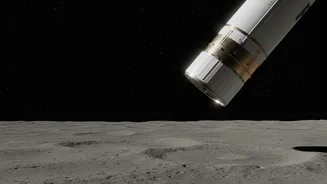
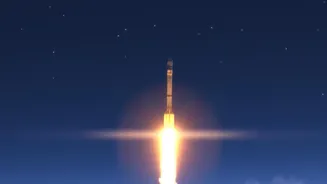
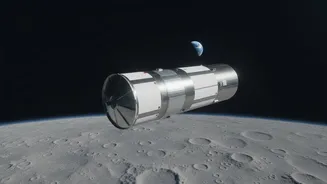
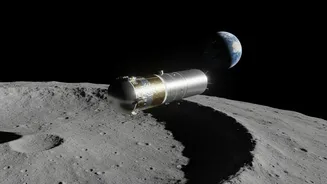
The object in question was the upper stage of a SpaceX Falcon 9 rocket, launched in January 2025 on a mission to deliver two lunar landers. After successfully completing its primary task, the rocket stage was left without enough fuel to either return
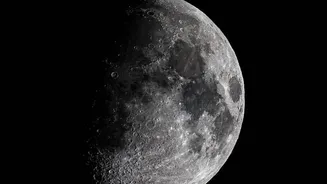
to Earth's atmosphere for a controlled burn-up or move into a stable parking orbit. It was abandoned in deep space. Over the next year and a half, the complex interplay of gravity from the Earth, Moon, and Sun, along with pressure from solar radiation, slowly altered its path. Astronomers who track near-Earth objects monitored its trajectory, eventually predicting with complete certainty that it was on a collision course with the Moon, set for August 5, 2026.
An Experiment by Accident
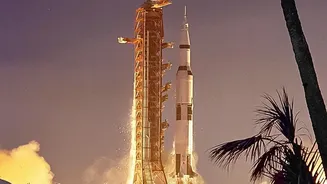
Crashes like this are not entirely new, but they are rare. In fact, scientists have a history of making them happen on purpose. During the Apollo program in the 1970s, NASA deliberately crashed the giant third stages of its Saturn V rockets into the lunar surface. The resulting impacts created artificial moonquakes, which were measured by seismometers left behind by astronauts. This allowed scientists to probe the Moon's internal structure. This accidental Falcon 9 impact offers a similar, if unplanned, opportunity. Knowing the object's exact mass, velocity, and size turns the crash into a valuable physics experiment, allowing researchers to study how craters are formed and how energy is transferred during an impact on a planetary body.
What We Learn From the Dust
The most significant scientific opportunity occurred in the immediate aftermath of the collision. The impact, which struck near the Moon's western limb, excavated tons of lunar soil, or regolith, throwing a massive plume of dust and vapor high above the surface. While the crash itself was not visible from Earth, this debris cloud was. Powerful instruments, like the European Southern Observatory's Very Large Telescope in Chile, were pointed at the Moon, ready to analyze the plume. By studying the light that passed through the debris, scientists detected the chemical fingerprints of sodium and lithium gas. This technique, called spectroscopy, allows researchers to understand the composition of material buried beneath the Moon's surface, potentially revealing the presence of water ice or other valuable resources without ever needing to land and dig.
A New Scar and Future Clues
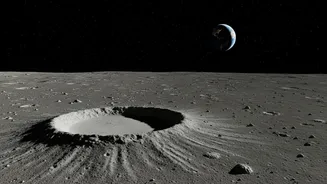
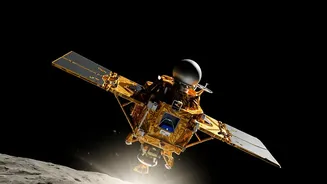
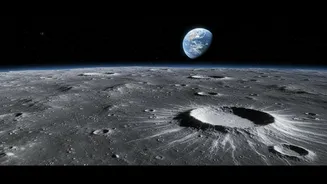
The science is not over yet. In the coming weeks, spacecraft orbiting the Moon, chiefly NASA's Lunar Reconnaissance Orbiter (LRO), will be tasked with finding the crash site. By comparing new images with older ones of the same area near Einstein Crater, they will be able to locate the fresh impact scar. The crater is expected to be around 60 to 100 feet wide. Studying its precise size, depth, and the pattern of ejected material will provide crucial ground truth for models that predict crater formation. This data is not just academic; it helps scientists better understand the risks that natural and artificial impacts pose to future lunar bases and astronauts exploring the surface.