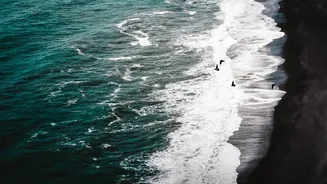






Picture a perfect beach. Chances are you see endless golden or white sand. But in some of the world's most dramatic landscapes, the shores are a striking, velvety black. This isn't an anomaly; it's a story written in fire and water.
A Story Forged in Fire
The most common reason
for black sand is volcanic activity. When molten lava flows into the ocean, the extreme temperature difference causes the lava to cool rapidly, shattering into tiny fragments of volcanic glass and rock. This explosive process can create enough material to form a new black sand beach almost overnight. The resulting material is primarily basalt, a dense, dark-coloured volcanic rock that forms the foundation of these unique coastlines. Beaches in places with significant volcanic histories, such as Hawaii, Iceland, and the Canary Islands, are famous for their dark shores precisely for this reason.
The Minerals That Make the Colour
The deep black colour comes from the specific minerals within the volcanic basalt. These rocks are rich in dark, iron and magnesium-heavy minerals like pyroxene and amphibole. Magnetite, a type of iron oxide, is another key component that contributes to the dark hue and the sand's often magnetic properties. Unlike the lighter-coloured quartz that makes up typical golden or white beaches, these mafic minerals absorb more light, giving the sand its distinctive jet-black appearance. These minerals are also much denser, which is why on a mixed-sand beach, you'll often see black streaks left behind after waves recede, as the heavier particles are sorted by the water's energy.
From Solid Rock to Grains of Sand
While a lava flow meeting the sea is the most dramatic way black sand is created, the process also happens over much longer timescales through simple erosion. Volcanic rock formations, both on the coast and further inland, are constantly weathered by wind, rain, and rivers. These forces break down the basalt into smaller and smaller pieces. Rivers and glacial meltwater can then carry these dark sediment particles for hundreds of kilometres to the coast, where the relentless action of ocean waves further grinds them into fine, uniform grains that carpet the shoreline. This ongoing process means that black sand beaches are not static; they are living landscapes, constantly being reshaped by the same natural forces that created them.
Dark Shores Across India
You don't have to travel to Iceland or Hawaii to witness this natural wonder. India's extensive coastline is also home to several stunning black sand beaches. In Karnataka, Tilmati Beach gets its name from the local words for sesame ('til') and soil ('matti'), as its fine black sand resembles the seeds. Kerala offers several dark-sanded escapes, including the serene Thiruvambadi Beach near Varkala, which provides a striking contrast to the area's famous red cliffs. Further south, the shores around Manavalakurichi in Tamil Nadu are known for their mineral-rich dark sands. And in the Andaman and Nicobar Islands, beaches like Kalipur Bay offer grey-to-black volcanic sands and are crucial nesting sites for several species of sea turtles.