







A Postcard from the Void
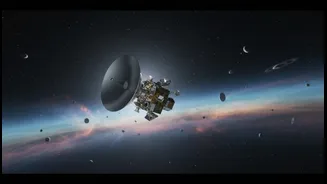
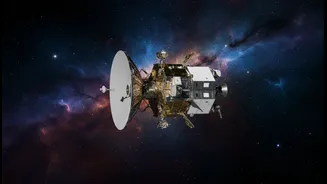
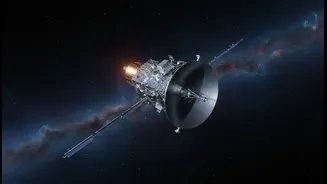
Launched in 2006, New Horizons made history with its breathtaking flyby of Pluto in 2015 and a subsequent visit to the Kuiper Belt Object Arrokoth in 2019. Now, over 9.5 billion kilometres away, it continues to speed through the frigid, radiation-filled
expanse beyond Neptune's orbit. On July 7, 2026, NASA confirmed the probe awoke from its latest and longest hibernation period in good health. This incredible longevity, far exceeding its primary mission, is a testament to its robust engineering. But the real treasure for future missions isn't just the scientific data it collects; it's the data about the spacecraft itself.
The Spacecraft's Diary
Every week, even during its long hibernations, New Horizons sends back a simple 'green' beacon, a status tone that tells mission controllers all is well. More detailed monthly reports provide a stream of telemetry, or 'health logs'. Think of this as the spacecraft's vital signs: temperature readings, power levels from its radioisotope thermoelectric generator, the status of its computers, and the performance of its instruments. This continuous stream of information is a real-world, long-term report on how systems behave, degrade, and survive in the harsh environment of deep space over decades. It’s the most detailed logbook we have for a journey of this length and distance.
Lessons in Longevity and Autonomy
Surviving deep space is about more than just having tough materials. It’s about being smart and resilient. The engineers at Johns Hopkins Applied Physics Laboratory designed New Horizons with significant redundancy and autonomous fault-correction capabilities. If a primary system has an issue, the spacecraft's software is programmed to troubleshoot and switch to a backup, often without any input from Earth. Given that a radio signal takes nearly nine hours to travel one way, this self-reliance is not a luxury, but a necessity. The health logs show how these systems have worked, which components have proven most reliable, and how the spacecraft has managed its limited power resources over two decades. These are priceless lessons in how to build a machine that can think for itself and endure for 50 years or more, a key requirement for future interstellar probes.
The Blueprint for Interstellar Probes
Scientists are already designing the next generation of explorers, like the ambitious Interstellar Probe concept. This future mission aims to travel far beyond where the Voyager probes and New Horizons have gone, potentially reaching 1,000 astronomical units from the Sun (for context, Pluto is about 40). To do this, a probe will need to operate autonomously for 50 years or longer. The engineering insights from New Horizons are a direct input for these designs. Its power management strategies, thermal control systems, and fault-protection software provide a proven blueprint. Knowing how New Horizons has handled component degradation helps engineers select better materials and build more effective backup systems for a craft that will be too far away for any quick fixes. The probe's journey is a critical step in planning for future interstellar travel.
From Explorer to Teacher
New Horizons began as a mission to explore the outer planets. Today, it serves a dual purpose. While its instruments continue to study the heliosphere—the protective bubble our Sun creates around the solar system—the spacecraft itself has become the subject of study. Its journey is no longer just about discovering what's out there; it's about learning how to get there and survive. The Voyager probes were pioneers that proved interstellar travel was possible, but they lacked the modern instruments to send back detailed engineering data over time. New Horizons, a more modern machine, is filling in those gaps. Its legacy won't just be the stunning photos of Pluto or Arrokoth, but the engineering wisdom that will guide humanity's first dedicated steps into the space between the stars.