







When we picture planets with rings, Saturn’s magnificent halo comes to mind. But it’s not alone; Jupiter, Uranus, and Neptune all have them. So why do the gas giants get all the cosmic jewellery, while rocky planets like Earth go without?
The Ingredients for a Ring
Planetary rings
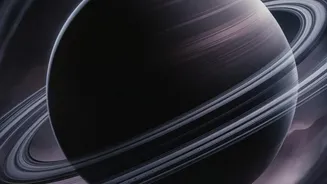
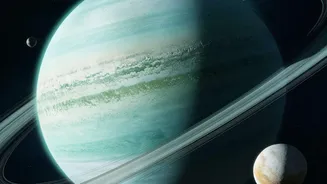
are not solid, hula-hoop-like structures. Instead, they are vast collections of countless individual particles orbiting a planet together. The composition varies: Saturn’s famous rings are made mostly of water ice, with chunks ranging from tiny specks to the size of a house. Jupiter’s rings, however, are much fainter and made of dark dust particles. The rings of Uranus and Neptune are also dark, narrow, and thought to be composed of carbon and tarlike organic compounds. No matter the material, all these particles act as tiny moonlets, each following its own orbit.
The Roche Limit: A Cosmic Danger Zone
The secret to why rings form instead of clumping together to create another moon lies in a concept called the Roche limit. Named after the astronomer Édouard Roche, this is a specific distance from a planet where its gravitational pull is so strong that it can tear other objects apart. A planet’s gravity pulls more strongly on the near side of a moon or asteroid than on its far side. If that object gets too close—inside the Roche limit—this tidal force overcomes the object's own gravity that holds it together, and it disintegrates. The resulting debris can't recombine into a new moon because the planet's gravity keeps pulling it apart, forcing it to spread out and form a ring.
Two Paths to Formation
Scientists have two main theories for how these rings come into being. The first theory suggests a destructive origin: a moon, asteroid, or comet wanders inside the planet's Roche limit and is ripped to shreds by tidal forces. The scattered debris then settles into the ring system we see today. Another possibility is that an existing moon is shattered by a high-speed collision with a comet or asteroid, with the resulting fragments forming a ring. The second major theory is that rings are leftovers from the planet’s formation. In the early solar system, not all the gas and dust in the disc around a young planet was incorporated into moons. Material that happened to be orbiting within the Roche limit would have been prevented from ever clumping together, remaining as a permanent ring system.
Why the Giants Wear the Rings
All four giant planets in our outer solar system—Jupiter, Saturn, Uranus, and Neptune—have rings. Their immense size and powerful gravity give them a much larger Roche limit, creating a wider zone where rings can form and remain stable. These planets are also located far from the Sun, beyond a boundary known as the 'frost line'. This cold region allowed vast quantities of ice, a key ingredient in bright rings like Saturn's, to survive. Furthermore, the gas giants have a large number of moons. This increases the chances for ring-forming events, whether it's moons being shattered by impacts or material being kicked up from a moon's surface by meteorites to supply a dusty ring.
The Case of the Ringless Inner Planets
So why are Mercury, Venus, Earth, and Mars bare? For one, being smaller, their Roche limits are much more compact, offering less real estate for stable rings to form. They also have very few moons compared to the outer giants, reducing the likelihood of ring-generating events. The biggest factor, however, is their proximity to the Sun. Any icy rings that might have formed would have been quickly vaporised by solar radiation. While rocky debris rings are possible, they would be much darker and less spectacular. Scientists believe Earth may have had a temporary debris ring after a massive collision that formed our Moon, but this material quickly coalesced instead of remaining as a permanent feature. Mars may one day get its own ring when its moon Phobos gets too close and is torn apart by gravity, but that's not expected for another 30 to 50 million years.