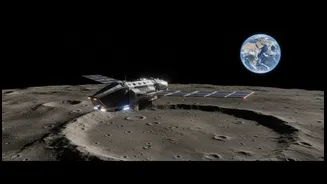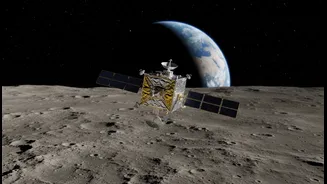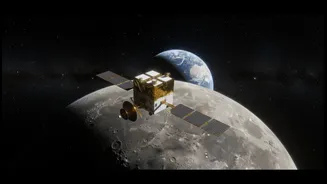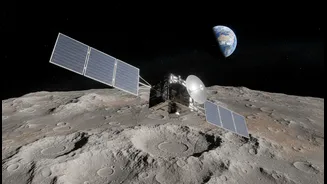






What Exactly is CAPSTONE?
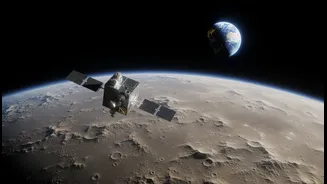
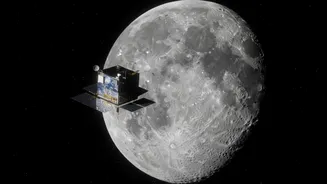
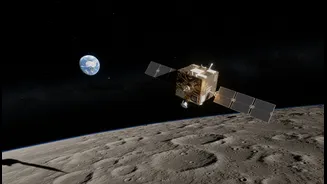
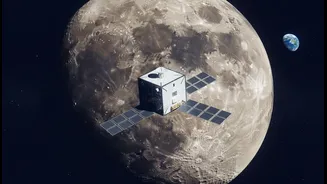
CAPSTONE is short for Cislunar Autonomous Positioning System Technology Operations and Navigation Experiment. Launched in June 2022, this 55-pound CubeSat is a pathfinder mission for NASA's Artemis program. Its main purpose is to test and verify a unique
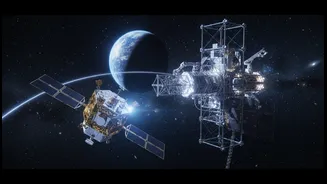
lunar orbit and demonstrate new navigation technologies that are critical for future missions, including the Lunar Gateway, a planned outpost for astronauts. Developed through a commercial partnership with the company Advanced Space, CAPSTONE represents a new, cost-effective way of doing business, designed to rapidly test key systems and reduce risks for more expensive, crewed missions to come. By June 2026, NASA confirmed that the spacecraft had achieved all of its primary and extended mission goals, successfully paving the way for the next chapter of lunar exploration.
A Unique Orbit Balanced in Space
At the heart of the mission is the testing of a never-before-used orbit called a Near-Rectilinear Halo Orbit, or NRHO. This highly elliptical path is located at a precise balance point between the gravities of the Earth and the Moon. This unique position provides long-term stability, requiring minimal fuel for a spacecraft to maintain its position, which is ideal for a long-term outpost like the Gateway. The orbit brings the spacecraft as close as 1,600 kilometers to one lunar pole and as far as 70,000 kilometers over the other. One of the key advantages of this path is that it ensures a continuous line of sight to Earth, allowing for uninterrupted communication. CAPSTONE was the first spacecraft to successfully enter and operate in an NRHO, validating NASA's models and proving that this fuel-efficient highway around the Moon is a viable and stable option.
Like GPS, But for the Moon
One of CAPSTONE's most groundbreaking tasks was to test an autonomous navigation system, essentially a lunar version of GPS. This technology, called the Cislunar Autonomous Positioning System (CAPS), is designed to allow spacecraft to determine their own position in space without constantly relying on tracking signals from Earth. To do this, CAPSTONE communicated directly with NASA's Lunar Reconnaissance Orbiter (LRO), which has been circling the Moon since 2009. By measuring its distance and relative speed to LRO, the CAPS software demonstrated it could calculate its own orbital position. This capability is crucial for a future where the cislunar environment becomes much busier with missions from various government and commercial entities, as it reduces the strain on Earth's limited deep space communication networks.
The Practical Choice for Reducing Risk
The entire CAPSTONE mission is a case study in making practical, cost-effective choices. Instead of launching a massive, multi-billion-dollar probe to test these unproven concepts, NASA opted for a small, relatively inexpensive CubeSat. This approach, leveraging commercial partnerships, allowed for a rapid and agile mission that could accept a higher level of risk to gain invaluable experience. The mission validated that the NRHO was as stable as models predicted and confirmed the power and propulsion requirements needed to stay there, significantly reducing logistical uncertainty for the far more complex and costly Gateway station. By using a small satellite to scout ahead, NASA gathered critical data and demonstrated key technologies at a fraction of the cost, ensuring that when larger, crewed missions fly, they do so with much greater confidence and safety.