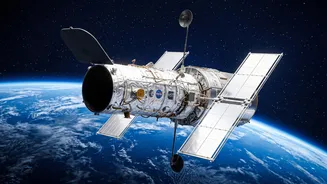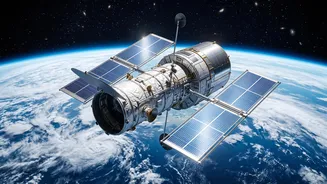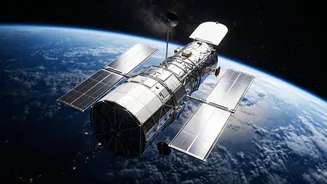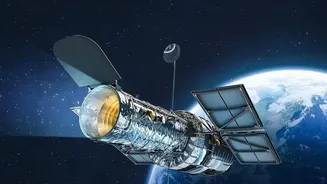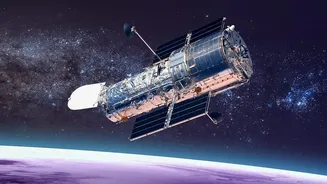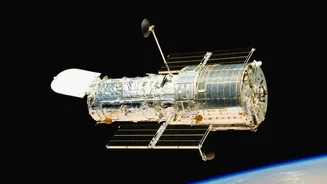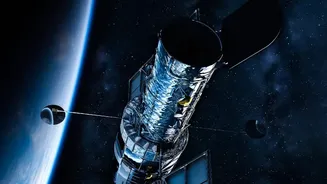



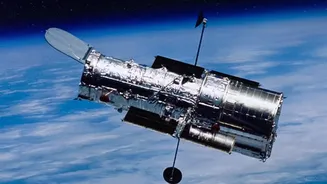
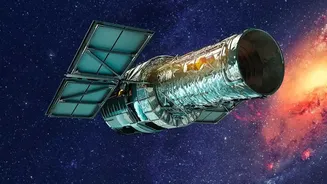
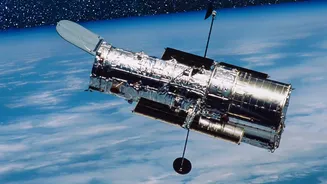
For over 35 years, the Hubble Space Telescope has been humanity's window to the cosmos. But its time may be running out. The iconic observatory is slowly falling, and NASA is now turning to the private sector for a rescue.
A Legacy Facing Orbital Decay
Since its launch in 1990, the
Hubble Space Telescope has been a monumental success, delivering over 1.7 million observations and fundamentally changing our understanding of the universe. But like all objects in low Earth orbit, it faces a persistent enemy: atmospheric drag. Even in the thin atmosphere about 500 kilometres up, tiny gas particles create resistance, slowly pulling the telescope downward. Hubble has no onboard propulsion to counteract this decay. Without a boost, NASA predicts it will re-enter Earth's atmosphere sometime between 2033 and 2034, ending its historic mission.
Why Saving Hubble Matters
While NASA's James Webb Space Telescope has captured headlines with its stunning infrared images, it is not a direct replacement for Hubble. The older telescope remains unique in its ability to observe in ultraviolet and visible light, capabilities that won't be matched by a new NASA flagship mission until the Habitable Worlds Observatory launches in the 2040s. Extending Hubble's life would bridge a crucial observational gap, allowing astronomers to continue studying everything from exoplanet atmospheres to the expansion rate of the universe for another 15 to 20 years. With over a thousand scientific papers still being published from its data each year, Hubble remains one of the most productive scientific instruments ever built.
A New Commercial Approach
In the past, Hubble was serviced exclusively by astronauts during Space Shuttle missions. The last such mission was in 2009. With the shuttles retired, NASA is now embracing the booming commercial space industry. In late October 2026, the agency issued a formal Request for Information (RFI), asking private companies for concepts. This isn't a firm contract but a market survey to see what's possible. The RFI outlines three potential missions: boost Hubble to a higher, more stable orbit of at least 600 kilometres; service it with new components; or guide it to a safe, controlled de-orbit at the end of its life. Companies must submit their ideas by the end of November 2026.
Who Could Answer the Call?
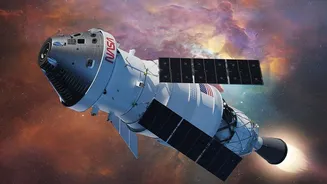
Several commercial players could be contenders. The idea of a private Hubble mission gained traction in 2022 when SpaceX and the Polaris Program, funded by billionaire Jared Isaacman, proposed a study on using a Dragon spacecraft for a reboost. While that specific plan was not pursued at the time, the new RFI reopens the door. The request is open to all, and other companies specializing in in-space servicing, like Astroscale and Momentus, have previously teamed up to propose robotic solutions for Hubble. The proposals could involve crewed missions, which offer flexibility, or uncrewed robotic 'tugs', which are generally less complex and risky. Any viable mission would need to be ready to fly by 2032 to be effective.