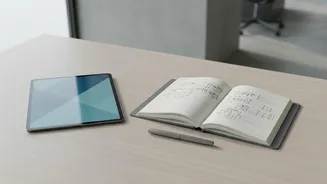








The Cognitive Edge of Handwriting
There's a certain magic to putting pen to paper, and science largely backs it up. Numerous studies have shown that handwriting engages the brain more deeply than typing. The physical act of forming letters creates complex connections between motor, sensory,
and language centers in the brain. This isn't just a quaint observation; it has real-world consequences for your workflow. Because handwriting is slower than typing, it forces you to process and summarize information rather than transcribing it verbatim. This active engagement leads to what researchers call "deeper encoding," which significantly improves memory retention and conceptual understanding. If you're in a meeting or lecture where you need to truly learn and recall complex ideas, the deliberate pace of handwriting gives your brain a crucial advantage.
The Unmatched Efficiency of AI
While handwriting wins on cognitive grounds, AI assistants dominate the field of sheer efficiency. In a fast-paced work environment, the ability to capture, organize, and retrieve information instantly is invaluable. Modern AI assistants can transcribe meetings in real-time, automatically identify key takeaways and action items, and create concise summaries—all without you having to divide your attention. This frees you up to stay fully present and engaged in the conversation. Furthermore, AI-powered tools provide unparalleled organizational power. Your notes are instantly searchable, shareable, and integrated across all your devices, eliminating the risk of losing that one crucial idea scribbled on a stray napkin. For tasks that require speed, volume, and seamless collaboration, AI is the clear champion.
Round 1: Speed and Organization
There's no contest here: AI assistants are exponentially faster. An AI can transcribe an hour-long meeting in minutes, a task that would be impossible for even the most diligent hand-writer. Organization is another landslide victory for AI. Digital notes can be tagged, sorted, and searched with a few clicks, creating a robust personal knowledge base. A paper notebook, for all its tactile charm, is a closed system. Finding a specific note from six months ago can mean a frustrating manual search, whereas an AI can retrieve it in seconds. However, some research has surprisingly found that for specific, structured tasks like filling out a calendar, people using paper can be faster because the physical object provides spatial cues that aid memory and focus.
Round 2: Memory and Learning
This round goes decisively to handwriting. The cognitive benefits are well-documented. Studies consistently find that students who take notes by hand demonstrate better recall and a deeper understanding of conceptual information compared to those who type. The very 'inefficiency' of handwriting—the need to slow down, listen, and synthesize—is what makes it so effective for learning. AI assistants, by contrast, promote a more passive form of information capture. While having a perfect transcript is useful for reference, the act of creating it does little to encode the information in your own memory. An AI captures information; handwriting helps you process it.
Round 3: Creativity and Ideation
For brainstorming and generating new ideas, the freeform nature of pen and paper often has the upper hand. Handwriting allows for non-linear thinking—you can sketch diagrams, draw arrows, and create mind maps in a way that feels restrictive on a screen. This physical act can stimulate brain regions associated with creativity and critical thinking. You're not just recording thoughts; you're visually structuring them. AI tools are rapidly evolving in this space, offering features like AI-powered mind mapping. They can help refine and organize initial ideas, but the initial spark—the messy, unstructured part of creativity—often thrives on the blank canvas of a physical notebook.
The Winner: A Hybrid Workflow
The smartest choice isn't to pick a side, but to build a bridge. The ultimate workflow for the modern professional combines the cognitive benefits of handwriting with the organizational power of AI. You can start by taking initial notes, brainstorming ideas, or outlining a project in a physical notebook to maximize learning and creativity. Then, use technology to bridge the gap. You could snap a photo of your notes and have an AI tool digitize them, or use a smart notebook that automatically sends your handwritten content to the cloud. This approach lets you engage deeply with the material during the crucial initial stages, then leverage AI to organize, search, and share your thoughts efficiently. It’s about using the right tool for the right cognitive task.