


A Sweet Discovery Near the Galaxy's Heart
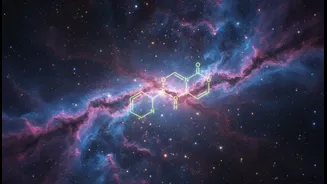
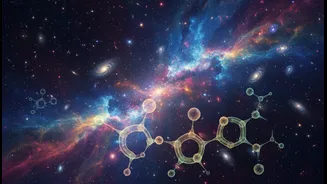
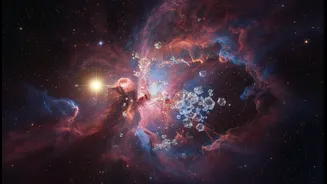
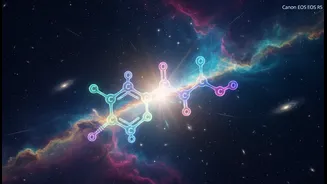
An international team of scientists has detected erythrulose, a four-carbon sugar, for the first time in the interstellar medium. The discovery was made in a massive, chemically rich molecular cloud named G+0.693-0.027, located about 26,745 light-years
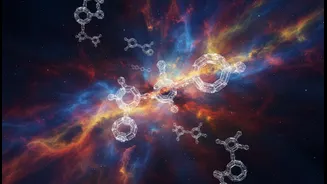
from Earth near the centre of our Milky Way galaxy. Using powerful radio telescopes in Spain, the Yebes 40-m and IRAM 30-m, researchers identified 12 distinct radio signals that perfectly matched the unique spectral 'fingerprint' of erythrulose. Here on Earth, this same sugar is found naturally in fruits like raspberries. Its detection in deep space, however, is a major milestone in understanding the chemistry that precedes life.
More Than Just a Simple Sugar
Sugars are vital for life as we know it, serving as energy sources and, crucially, as the structural backbone of DNA and RNA. While simpler molecules have been found in space before, the discovery of erythrulose is significant because of its complexity. With four carbon atoms, it represents a step up from previously detected two-carbon sugars. This makes it one of the most complex non-cyclic molecules ever identified in the interstellar medium. The finding challenges long-held theories that complex molecules in space form by sequentially adding one carbon atom at a time. Instead, erythrulose was found to be at least eight times more abundant than any three-carbon sugars, which were surprisingly absent. This suggests a different, more efficient formation pathway is at play on the icy surfaces of cosmic dust grains, where simpler two-carbon molecules combine.
A Key Ingredient for the Origin of Life
This discovery provides a tantalising link to the origins of life on our own planet. A leading theory, known as the 'RNA world' hypothesis, suggests that RNA, not DNA, was the first genetic material. However, the five-carbon sugar that forms RNA's backbone, ribose, is difficult to synthesise under the conditions of early Earth. Some astrobiologists propose that life may have started with a simpler genetic polymer called Threose Nucleic Acid (TNA), which is built on a four-carbon sugar. In the presence of water, erythrulose can be converted into sugars like threose. Therefore, finding erythrulose in space supports the idea that the chemical precursors for life weren't necessarily made on Earth. Instead, they could have been delivered to our young planet billions of years ago by comets and asteroids during a period known as the Late Heavy Bombardment.
Why This Story Matters Now
For decades, scientists have catalogued a growing list of organic molecules in space, but a true sugar had remained elusive until now. This discovery bridges a major gap in the theory of an 'exogenous origin' of life's building blocks—the idea that they came from space. It confirms that the chemistry needed to create biologically relevant molecules is not unique to planets but is active in the vast, cold nurseries where stars and planets are born. The discovery of erythrulose now shifts the focus of research. The question is no longer if complex prebiotic molecules exist in space, but how complex they can become. This opens the door to searching for even more significant molecules, such as ribose itself.
The Search for Life's Cosmic Recipe
The detection of erythrulose is not the end of the story, but rather a thrilling new chapter. It energises the scientific community to continue scouring the cosmos for other key ingredients of life. Future observations with increasingly sensitive telescopes will aim to find other sugars and complex organics in different interstellar clouds across the galaxy. By mapping the distribution of these molecules, scientists hope to build a more complete picture of the chemical inheritance of young planetary systems. Understanding how common these ingredients are helps us assess the possibility that life could arise elsewhere in the universe. Each new molecule identified in these stellar nurseries brings us closer to understanding our own planet's history and our place in the cosmos.