
The Toss That Sparked Debate
The day began with a decision that is debated to this day. Indian captain Sourav Ganguly won the toss and, on a sun-drenched Johannesburg morning, chose to field first. The logic was to exploit any early morning moisture on a pitch that had been under
covers. However, it was a gamble. It put India in the high-pressure situation of chasing a target in a World Cup final against the defending champions, an unbeaten and intimidating Australian team. Australian captain Ricky Ponting later admitted he would have chosen to bat first anyway, highlighting the strategic advantage India may have surrendered.
An Opening Over Riddled with Nerves
The pressure of the occasion became immediately apparent. Zaheer Khan, India's pace spearhead, opened the bowling. His first over was a chaotic mix of wides and no-balls that cost a staggering 15 runs. This nervous start not only gave Australian openers Adam Gilchrist and Matthew Hayden a flying start but also set a tense and undisciplined tone for the Indian bowling attack. Australia seized the momentum, and the Indian bowlers, who had been so effective throughout the tournament, suddenly looked overwhelmed.
Ponting's Unforgettable Onslaught
After the openers laid a foundation with a 105-run partnership, Ricky Ponting came to the crease and played one of the greatest innings in World Cup final history. He started cautiously, reaching his first 50 runs from 74 balls. But once he was set, he unleashed a breathtaking assault. Ponting finished with an unbeaten 140 off 121 balls, an innings studded with eight powerful sixes. He was ably supported by Damien Martyn, who scored a crucial 88 not out despite nursing a broken finger. Their record-breaking partnership of 234 runs took the game completely away from India, posting a mammoth total of 359 for 2.
The Chase and the Fall of a Nation's Hope
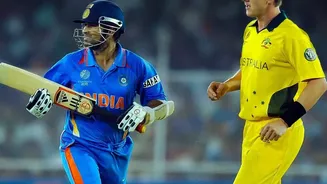
Chasing 360 to win a World Cup was a monumental task, and India's hopes rested heavily on the shoulders of Sachin Tendulkar, the tournament's leading run scorer. Those hopes were dashed in the very first over of the chase. Tendulkar, attempting to pull a short ball from Glenn McGrath, was caught and dismissed for just four runs. A collective gasp was felt across India; the dismissal was a massive psychological blow from which the team never truly recovered.
A Lone Fight in a Losing Battle
Virender Sehwag fought valiantly, playing a brisk innings of 82 from 81 balls to keep a glimmer of hope alive. He and Rahul Dravid, who scored 47, tried to build a resistance. However, the relentless pressure of the scoreboard and a worldclass Australian bowling attack, led by McGrath and Brett Lee, proved to be too much. Wickets fell at regular intervals after Sehwag's dismissal, and the Indian innings eventually folded for $234$, falling short by $125$ runs.