





The Basic Idea: A Planetary Eclipse
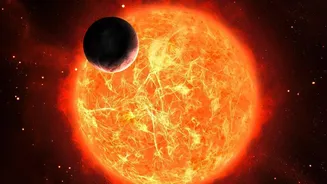
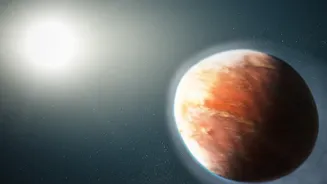
Imagine watching a distant lighthouse and seeing a tiny gnat fly across the beam. For a moment, the light dims ever so slightly. That's the basic principle behind the transit method, which has helped astronomers discover thousands of exoplanets. A 'transit'
occurs when a planet passes directly between its star and our telescopes. By measuring the dip in the star's brightness, scientists can calculate the planet's size. But the real magic happens when that planet has an atmosphere. As the planet crosses its star, a sliver of starlight filters through the very edge of the planet’s air before reaching us here on Earth.
Reading a Chemical 'Barcode'
That filtered starlight holds the key. The technique of spectroscopy involves splitting light into its component colors, like a rainbow created by a prism. Different gases in an atmosphere absorb very specific colors, or wavelengths, of light. So, when starlight passes through an exoplanet's atmosphere, molecules like water vapor, methane, or carbon dioxide leave behind a unique chemical fingerprint—a pattern of missing colors. By comparing the star's spectrum during the transit to its normal spectrum, astronomers can identify these missing bands and read the 'barcode' to determine which gases are present in the planet's air.
What Can This Tell Us?
This atmospheric barcode can reveal a wealth of information. The presence of water vapor, for instance, is a key ingredient for life as we know it. Detecting methane and carbon dioxide can provide clues about a planet's geological or biological activity. The ultimate goal for many is to find 'biosignatures'—gases like oxygen, ozone, or nitrous oxide that are overwhelmingly produced by life here on Earth. Finding these gases wouldn't be definitive proof of extraterrestrial life, as they can sometimes be produced by non-biological processes, but it would make a planet an extremely compelling candidate for further study. The data also helps scientists understand if a planet has clouds or haze, which can affect its climate.
The Power of Webb and Future Telescopes
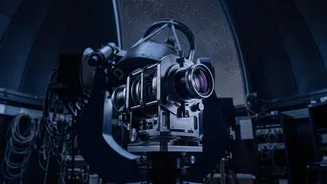
This is an incredibly difficult measurement to make. The signal from an exoplanet's atmosphere is minuscule; for an Earth-like planet, the effect can be as small as a few parts per million. This is where advanced observatories like the James Webb Space Telescope (JWST) come in. Positioned in space, JWST avoids the interference of Earth's own atmosphere, which blocks many of the infrared wavelengths where molecular signatures are most prominent. With its massive mirror and sensitive spectrographs, JWST can detect these faint chemical fingerprints with unprecedented precision, transforming our ability to characterize worlds orbiting distant stars.
Challenges and Limitations
For all its power, transit spectroscopy has its limits. First, the method only works for planets whose orbits are perfectly aligned from our point of view, causing them to transit their star. Second, the signal is so faint that it can be easily confused with 'noise' from stellar activity, like starspots, or instrumental variations. High-altitude clouds or thick haze on an exoplanet can also mute or completely block the atmospheric signal, leaving astronomers with a flat, uninformative spectrum. This makes finding rocky, Earth-sized planets with clear atmospheres a top priority in the ongoing search for habitable worlds.