

The Sun's Inevitable Twilight
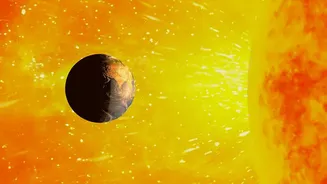
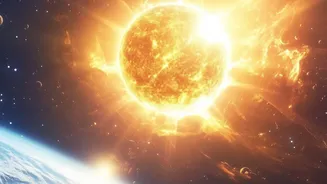
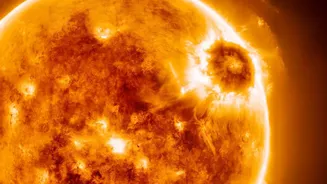
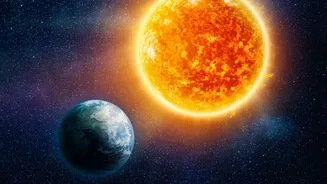
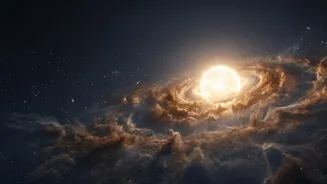
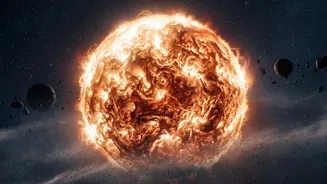
Every star has a life cycle, and our Sun is already middle-aged. In about five billion years, it will exhaust the hydrogen fuel in its core and begin to die. This process will see it swell into a 'red giant', a star so enormous it will consume the inner
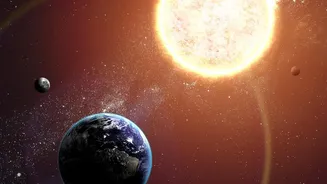
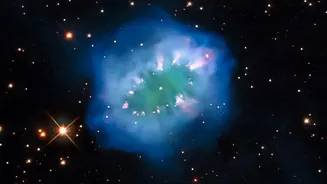
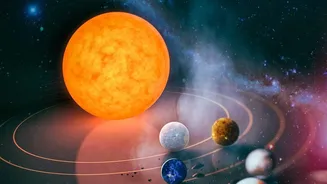
planets: Mercury, Venus, and very likely Earth itself. After this destructive phase, the Sun will shed about half its mass and collapse into a white dwarf—a hot, dense, Earth-sized ember that will slowly cool over trillions of years. For a long time, scientists believed that while the inner solar system was doomed, the gas giants—Jupiter, Saturn, Uranus, and Neptune—would survive, their orbits gently expanding as the Sun's gravitational grip weakened. The old thinking was that they would circle their dead star for an almost unimaginable length of time, perhaps up to a quintillion years, until a passing star finally knocked them askew.
A New, More Violent Prediction
Recent research, however, paints a much more violent and compressed picture of our system's demise. A study from Caltech researchers challenges the core assumption that the Sun will lose its mass smoothly. Instead of a gentle, consistent process, the new models suggest the Sun will die in a series of turbulent, lopsided ejections of matter. Think of it less like a deflating balloon and more like a sputtering engine. These uneven bursts will create what the scientists call 'stochastic kicks'—small but significant gravitational shoves that will be felt by the remaining planets. This new insight fundamentally changes the timeline for the end of our solar system, relocating the cause of its destruction from a random external event to the death throes of the Sun itself.
The Beginning of the End
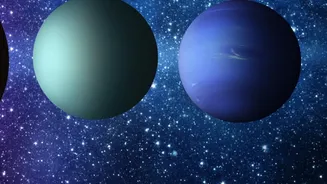
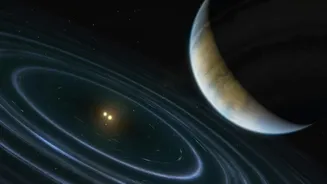
According to the new simulations, this chaotic mass loss will have profound consequences. As the Sun's gravity weakens, the orbits of Jupiter, Saturn, Uranus, and Neptune will indeed expand. But the additional gravitational 'kicks' from the Sun's messy demise will nudge them into unstable arrangements. Planets that have kept a respectful distance for billions of years may be pushed into new orbital resonances, where their gravitational pulls start to amplify each other in a chaotic dance. This can lead to orbits crossing, dramatic gravitational wrestling matches, and ultimately, planets being ejected from the solar system entirely. Some simulations even showed Uranus and Neptune swapping orbits before the system tore itself apart.
A Drastically Shorter Timeline
The most startling conclusion of the study is just how much this shortens the period of stability. Instead of lasting for 100 billion or even a quintillion years, the new models predict the outer solar system is likely to become unstable and fly apart within just one to three billion years after the Sun becomes a white dwarf. In some scenarios run on the supercomputers—about 40% of them—the instability began even earlier, while the Sun was still in its red giant phase, before it had even finished dying. It seems that Isaac Newton's original suspicion that the planetary order was mortal was correct, though he was mistaken about the perpetrator. It won't be the planets' own gravity slowly unravelling the system, but rather the Sun itself that, in the words of the researchers, 'shakes it, and more often than not, spills it'.