



Seeing Through the Dust
One of the biggest challenges in astronomy is cosmic dust. These tiny particles, scattered throughout galaxies, act like a thick fog, blocking visible light. This has long prevented us from seeing what’s happening inside stellar nurseries, where new stars
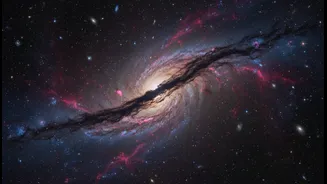
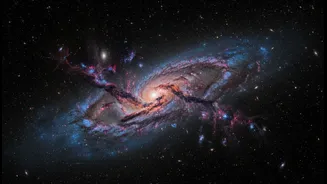
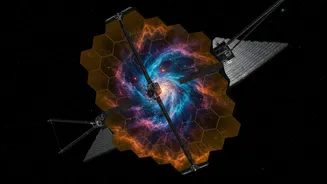
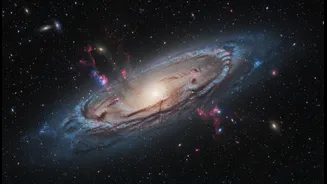
are born, or at the dense centres of galaxies. Infrared light, however, has a longer wavelength that can slip past these dust particles more easily. Telescopes like the JWST, which are optimised to detect this light, can therefore peer into these previously hidden regions. For example, recent observations of the galaxy Centaurus A cut through dust lanes that completely obscured the view for the Hubble Space Telescope, revealing the chaotic and complex inner workings of the galaxy in unprecedented detail.
A Journey Back in Time
Because the universe is expanding, light from the most distant objects gets stretched as it travels across space. Light that was originally emitted as visible or ultraviolet light from the very first stars and galaxies reaches us today as infrared light—a phenomenon known as redshift. Infrared telescopes are essentially time machines, allowing us to capture this ancient light and see the universe as it was just a few hundred million years after the Big Bang. This capability has enabled astronomers to study the formation of the first galaxies and get clues about the early universe's conditions. For instance, JWST has identified some of the earliest supernovas and observed black holes that formed before their host galaxies, challenging existing models of cosmic evolution.
Unveiling Galactic Archaeology
The new level of detail from infrared telescopes is allowing for what scientists call 'galactic archaeology'. By resolving individual stars even in the crowded, dusty centres of galaxies, astronomers can start to build a precise timeline of a galaxy's history. They can map out when different generations of stars were born, when a galaxy collided with another, and when bursts of star formation were triggered or shut down. In Centaurus A, JWST's resolution allows astronomers to study the region on a star-by-star basis, piecing together when older stars died out and when a collision two billion years ago sparked a frenzy of new star birth.
Answering New, More Complex Questions
This transformative technology is not just about confirming old theories; it's about raising new, more complex questions. We are now able to study the intricate dance between supermassive black holes and their host galaxies. Recent data shows how a black hole can both trigger star formation by compressing gas and simultaneously choke it off by blowing essential materials away. Furthermore, astronomers have detected a surprising variety of complex organic molecules, like benzene and methane, deep inside dusty galaxies, raising new questions about the chemistry of the universe. These findings push the boundaries of our knowledge and force scientists to refine their models of how galaxies work.