




A Planet of Intense Interest
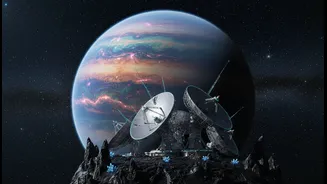
Located 124 light-years away, K2-18b is a planet unlike anything in our solar system. It’s a “sub-Neptune,” larger than Earth but smaller than Neptune, and it orbits its star within the habitable zone—the region where liquid water could exist. Observations
by the James Webb Space Telescope (JWST) have made it a prime target for astrobiologists. The telescope detected methane and carbon dioxide in its hydrogen-rich atmosphere, consistent with a theoretical “Hycean” world: a planet with a deep liquid water ocean beneath its thick atmosphere. The intrigue deepened with a tentative, though heavily debated, detection of dimethyl sulfide (DMS), a gas that on Earth is predominantly produced by marine life. This tantalizing possibility, however slim, has prompted scientists to look for more than just biological clues, but for signs of technology itself.
Cosmic Ears: The VLA and MeerKAT
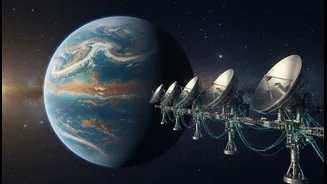
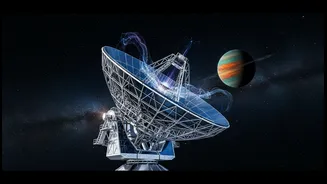
To listen for alien technology, or “technosignatures,” astronomers turn to radio telescopes. The search for signals from K2-18b involved two of the world's most powerful facilities: the Karl G. Jansky Very Large Array (VLA) in New Mexico, USA, and the MeerKAT telescope in South Africa. The VLA consists of 27 massive dish antennas arranged in a Y-shape that can span up to 36 kilometers, acting as a single, gigantic eye on the universe. MeerKAT is a precursor to the even larger Square Kilometre Array and is itself a highly sensitive instrument. By combining the power of these two observatories, astronomers can conduct a search that is both broad in its frequency coverage and incredibly sensitive, capable of detecting signals far weaker than previous efforts.
The Search for an Artificial Needle
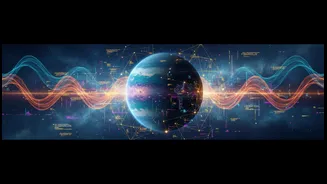
The core idea behind searching for technosignatures is that technology produces signals that nature does not. While the cosmos is full of radio noise from stars, galaxies, and other natural phenomena, this background hum is typically “broadband,” meaning it’s spread across a wide range of frequencies. An artificial signal, like a communication beacon or radar, would likely be “narrowband”—concentrated into a very specific, narrow frequency. It’s the difference between the roar of a waterfall and a single, clear whistle. The goal of a technosignature search is to find that whistle amidst the roar. This is precisely what the VLA and MeerKAT were tasked to do in their coordinated observation of K2-18b.
Filtering the Cosmic Static
Finding a single narrowband signal among the millions of radio sources in the sky and the flood of human-made interference from Earth is a monumental task. This is where advanced filtering techniques become crucial. Scientists use a multi-layered approach to weed out false positives. First, they eliminate known interference from satellites and ground-based sources. A key technique involves using the telescopes' multiple beams; a true signal from K2-18b should only appear in the beam pointed directly at the planet, while Earth-based interference would likely show up across the sky. Another filter looks for a Doppler drift. Since the planet is moving in its orbit, any signal from it would shift in frequency in a predictable way, much like how an ambulance siren changes pitch as it passes by. Signals with no drift are almost certainly from Earth. By applying these filters, astronomers can dramatically reduce the millions of potential signals to a manageable few for closer inspection.
The Verdict and the Future
In a recent, comprehensive search of K2-18b, a team of astronomers used the VLA and MeerKAT to listen for a full orbital period of the planet—about 33 days. After sifting through millions of candidate signals across a wide range of frequencies, they found no confirmed technosignatures. While this null result might seem disappointing, the project was a landmark success in another way. It established a powerful new framework for conducting technosignature searches, combining the capabilities of multiple observatories and sophisticated, automated filtering systems. This methodology makes future searches faster and more effective. The silence from K2-18b doesn't mean we are alone; it simply sets a limit on the kinds of signals we can currently detect. The search was a powerful demonstration of our growing ability to listen for our cosmic neighbors, refining the tools we will need when a signal finally arrives.