





From Dots on a Chart to Dynamic Worlds
Until recently, our knowledge of exoplanets—planets orbiting stars other than our Sun—was largely statistical. We knew there were thousands of them, and we could measure their size, mass, and how long they took to orbit their star. But each one was essentially
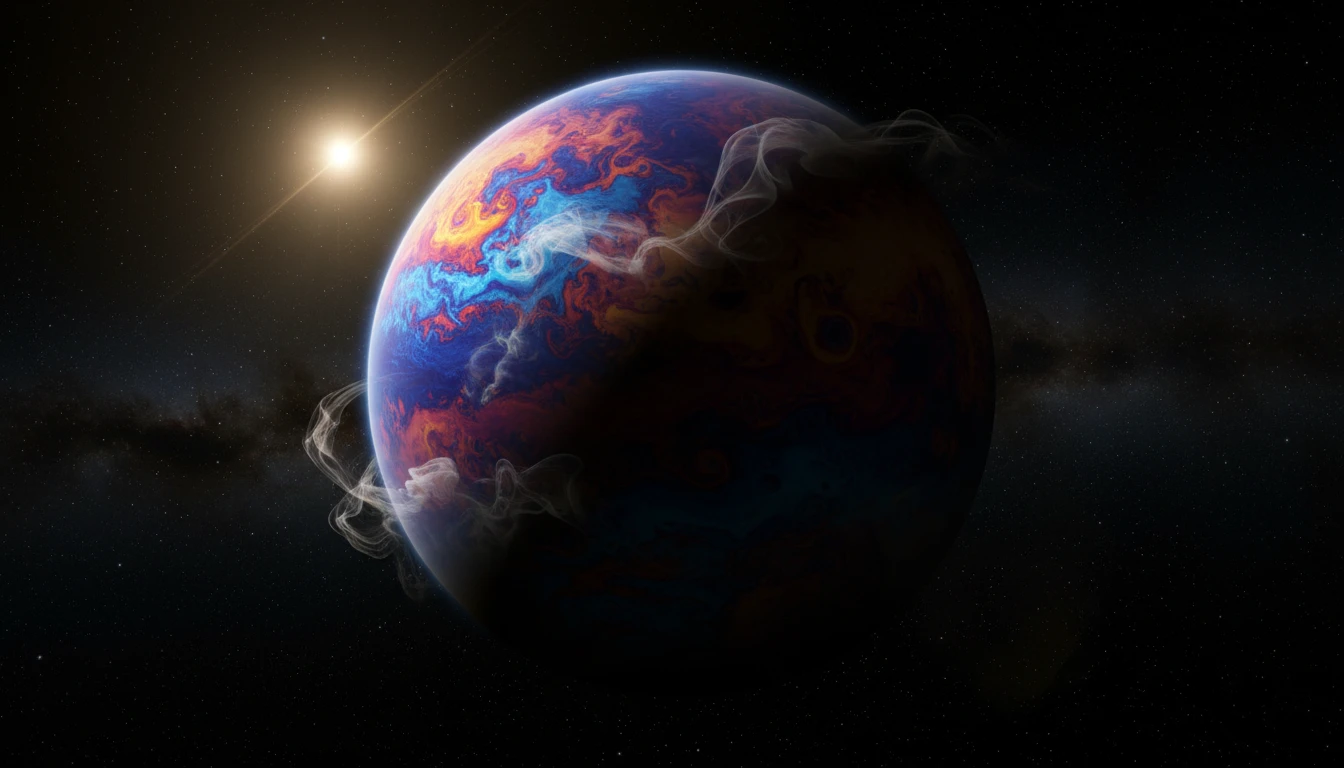
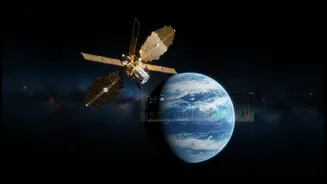
a data point, a shadow passing in front of a distant star. We could guess what they were like, but we couldn't truly see them. This is now changing dramatically. A revolution in astronomy is underway, powered by instruments like the James Webb Space Telescope (JWST), shifting the focus from planetary discovery to deep characterization. We are entering an era where we can ask not just 'is there a planet?' but 'what is the weather like on that planet?'.
A Cosmic CAT Scan for Alien Skies
Mapping an object hundreds of light-years away that we can't see directly sounds like science fiction, but astronomers are achieving it with incredible ingenuity. The primary technique is called spectroscopy. When an exoplanet passes in front of its star, a tiny fraction of the starlight filters through the planet's atmosphere. By capturing this light with a powerful telescope like the JWST, scientists can see which wavelengths, or colours of light, have been absorbed. Different chemical elements and molecules absorb light at specific, known wavelengths, creating a unique barcode that reveals the atmosphere's composition. A more advanced technique, known as spectroscopic eclipse mapping, takes this even further. By observing the minute changes in light as a planet orbits and passes behind its star, scientists can reconstruct a three-dimensional picture of its atmosphere, mapping temperature and chemical composition across different longitudes, latitudes, and even altitudes. It's like performing a CAT scan on a planet from light-years away.
The Weather Forecast for a Hot Jupiter
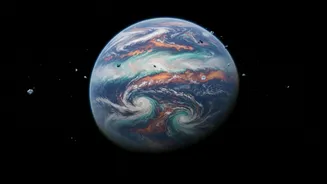
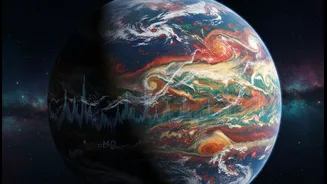
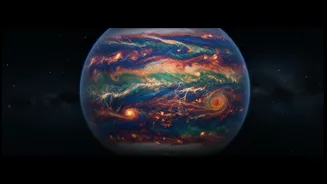
Some of the most stunning early results have come from studying 'hot Jupiters'—gas giants orbiting extremely close to their stars. On a planet named WASP-43 b, which is 280 light-years away, scientists used JWST to create a detailed temperature map. They found scorching dayside temperatures of nearly 1,250 degrees Celsius, hot enough to forge iron, while the permanently dark nightside was a significantly cooler 600 degrees Celsius. This data also revealed powerful equatorial winds whipping around the planet at over 8,000 kilometres per hour. On another world, WASP-18b, the heat is so intense—reaching nearly 2,760 degrees Celsius—that observations suggest water molecules are being torn apart. These are not just abstract facts; they are the first brushstrokes in a gallery of alien climates, showing us that distant worlds have active, complex weather systems.
A Breakthrough for Rocky, Earth-like Worlds
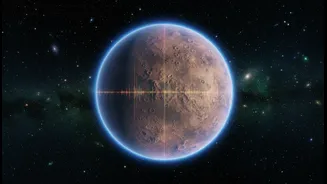
While mapping hot Jupiters is impressive, the ultimate goal for many is to study smaller, rocky planets that could potentially harbour life. Just recently, in a landmark discovery, scientists found the strongest evidence yet of an atmosphere on a rocky planet within its star's habitable zone. The planet, LHS 1140 b, is about 48 light-years away and showed the distinct signature of helium escaping from its atmosphere. This is a monumental finding because it proves that rocky planets in potentially habitable conditions can hold onto an atmosphere, a crucial ingredient for life as we know it. Until now, it was an open question whether the harsh radiation from their stars would strip such atmospheres away. This discovery transforms LHS 1140 b into one of the most promising targets for future astrobiological study.