




From the Cosmos to the Lab
Black holes are regions of spacetime so dense that nothing, not even light, can escape their gravitational pull. For decades, they have been a source of fascination and a theoretical playground for physicists like Stephen Hawking. He predicted that black
holes should emit a faint thermal glow, now known as Hawking radiation. Directly observing this from an actual black hole is impossible with current technology. So, scientists got creative. They began building 'analogue' black holes in the lab—not by crushing matter to infinite density, but by using other physical systems that are described by the same mathematical equations.
How to Build a 'Black Hole'
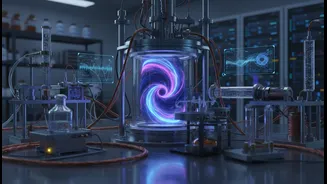
You can't order a black hole online, but you can simulate its key feature: the event horizon, the point of no return. Scientists have ingeniously created these analogues using various media. Some use quantum fluids like Bose-Einstein condensates, supercooling atoms to near absolute zero and using lasers to create a flow where sound waves get trapped, much like light in a real black hole. Others use giant tanks of water with a vortex in the middle, where waves interacting with the vortex mimic the behavior of light or matter swirling around a black hole. More recently, researchers have used special optical fibers and even single-atom chains to simulate the event horizon and observe phenomena similar to Hawking radiation. These experiments are not creating actual gravitational monsters; they are creating systems that allow physicists to test their theories in a controlled environment.
The Graphene Connection
One of the most exciting frontiers in this field involves a material already famous for its potential: graphene. Theoretical physicists have proposed that an irregularly shaped flake of graphene, when placed in a magnetic field, can act as a holographic model of a quantum black hole. This concept, known as the Sachdev-Ye-Kitaev (SYK) model, allows a complex, higher-dimensional system (the black hole) to be represented in a simpler, lower-dimensional one (the graphene flake). The beauty of this approach is its relative simplicity; it doesn't require exotic fabrication techniques. Studying the electronic properties of such a graphene flake could reveal deep truths about the interplay between gravity and quantum mechanics.
Beyond Theory: New Materials
This is where the conversation pivots from pure physics to practical materials science. The theories and mathematical tools developed to understand black holes are proving surprisingly useful for describing the behavior of electrons in certain advanced materials. In what's known as the 'strongly coupled' regime, electrons can behave like a viscous fluid, a state that traditional theories struggle to explain. The mathematics of black hole physics, however, offers a new way to calculate properties like viscosity in these exotic electron fluids. Researchers are now using these gravity-inspired methods to predict and design new quantum materials with specific electronic properties. One such proposed material, Scandium-substituted Herbertsmithite, is predicted to have an electron coupling effect over three times stronger than graphene, potentially opening the door to studying new physical phenomena like electronic turbulence.
A Bridge Between Worlds
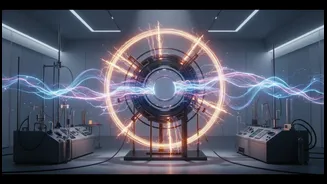
The link, therefore, is not about building black hole-powered devices. It's about a powerful intellectual exchange. The extreme physics of gravity provides a new language and toolkit for condensed matter physicists who are trying to create the materials that will power future technologies in quantum computing and advanced electronics. A recent breakthrough, for example, used a stationary ring of metamaterials to successfully recreate the energy-extraction process proposed by physicist Roger Penrose in 1969, avoiding the impossible mechanical speeds previously thought necessary. This lab model demonstrates a practical path from abstract theory to potential applications in optics and wireless communication. The study of black hole analogues is creating an unexpected but fruitful bridge between two of the most fundamental and forward-looking fields in science.