
Staring Into The Void
To see the beginning of the universe, astronomers have to look very, very far away. Because light takes time to travel, the light from a galaxy a billion light-years away is a billion years old. But these first galaxies are incredibly faint. The solution
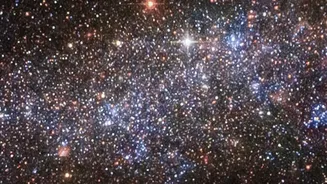
is a technique called deep field imaging. Telescopes like the James Webb Space Telescope (JWST) point at a seemingly empty, dark patch of the sky for hundreds of hours. By collecting light for so long, they can capture the faint glow of the most distant objects in the cosmos, effectively creating an image of the universe as it was more than 13 billion years ago. This slice of the universe, often no bigger than a grain of sand held at arm's length, can contain thousands of galaxies.
The Infrared Advantage
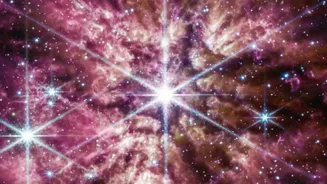
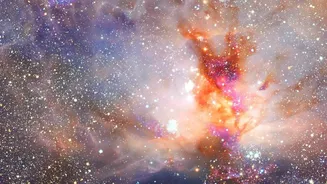
The key to this cosmic time travel lies in infrared light. The universe has been expanding since the Big Bang, and as it expands, it stretches the light traveling through it. Light that left the first stars and galaxies as visible or ultraviolet light has been stretched into the infrared spectrum by the time it reaches us. This is where JWST's powerful sensors excel. Its Near-Infrared Camera (NIRCam) and Mid-Infrared Instrument (MIRI) are specifically designed to detect this faint, ancient light. These cutting-edge detectors are incredibly sensitive, able to pick up photons that have traveled for billions of years. This infrared vision also allows the telescope to peer through the cosmic dust that would otherwise obscure our view of these stellar nurseries.
Rewriting Cosmic History
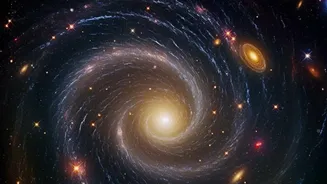
These sensors are not just taking pretty pictures; they are gathering data that is fundamentally changing our understanding of early cosmic processes. One of the biggest surprises is that the first galaxies appear to have formed much earlier and grown more massive than theories predicted. Astronomers have found surprisingly large and well-organized spiral galaxies existing when the universe was less than two billion years old. Recent studies using JWST also suggest that these early galaxies contained many more faint, low-mass stars than previously thought, making them up to four times more massive than earlier estimates. This challenges existing models of galaxy formation, suggesting the process was faster and perhaps more chaotic than we knew.
The Universe's First Dawn
JWST is also providing crucial insights into a period known as the Era of Reionization. For hundreds of millions of years after the Big Bang, the universe was filled with a neutral, opaque fog of hydrogen gas. It wasn't until the first stars and galaxies formed that their intense ultraviolet light began to ionize this gas, burning away the fog and making the universe transparent. For the first time, JWST has provided direct evidence of small galaxies clearing out ionized bubbles around them, showing exactly how this cosmic dawn unfolded. Scientists are also using the telescope's spectrographs to detect the chemical signatures in these early galaxies, which helps them understand the lifecycle of the very first stars.
From 'Red Dots' to Our Home
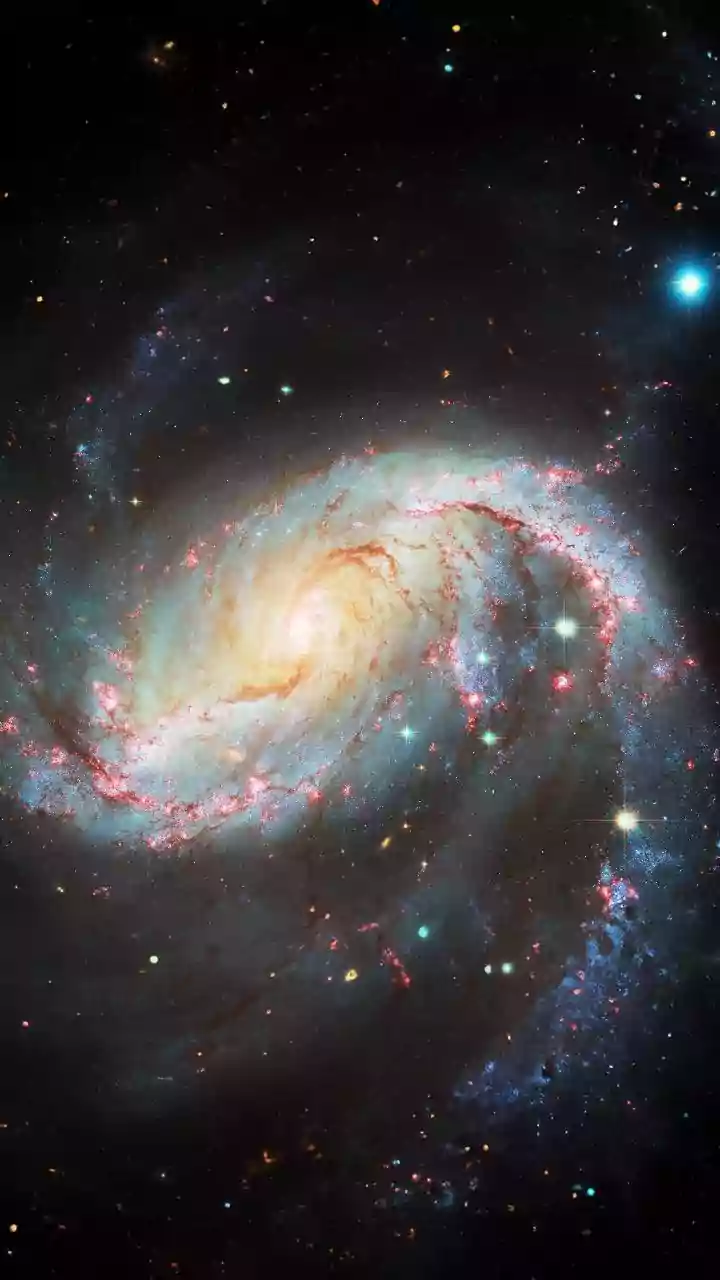
Some of the most intriguing targets are the mysterious 'little red dots' scattered across deep field images. These are thought to be extremely distant, compact objects, possibly hosting actively growing supermassive black holes in the universe's first billion years. Understanding how these objects, and the galaxies they inhabit, formed provides the foundation for everything that came after. The processes that built these chaotic early systems are the same ones that eventually led to the creation of spiral galaxies like our own Milky Way. By studying the universe's first billion years, we are uncovering our own cosmic origins and the chain of events that led to the formation of our sun, our planet, and life itself.