



Between a Star and a Planet
Imagine an object that forms from a collapsing cloud of gas and dust, just like a star, but never quite makes it. That’s a brown dwarf. These celestial bodies are more massive than planets like Jupiter but lack the immense gravitational pressure needed
to ignite and sustain the hydrogen fusion that powers stars. Because they don't have a stellar engine, they are incredibly dim and difficult to detect, glowing faintly from the residual heat of their formation and slowly cooling over billions of years. For years, they were largely theoretical, but advancements in infrared astronomy have brought them out of the cosmic shadows. Astronomers consider them a crucial link between star formation and planet formation, occupying a mysterious middle ground. Their atmospheres are not just simple balls of gas; they are dynamic places where complex chemistry occurs and clouds can form, not of water, but of exotic materials like silicate dust and iron droplets.
A New Eye on the Cosmos
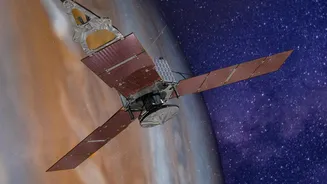
Enter NASA's SPHEREx (Spectro-Photometer for the History of the Universe, Epoch of Reionization, and Ices Explorer). Launched in March 2025, this space telescope is on a mission to map the entire sky in near-infrared light, which is invisible to the human eye. While its primary goals are to study the origins of the universe and search for the ingredients of life, its unique capabilities make it a perfect tool for hunting brown dwarfs. SPHEREx measures the brightness of celestial objects across 102 different colour bands. This technique, called spectroscopy, allows scientists to see the chemical fingerprints of different molecules in an object's atmosphere. Different molecules absorb and emit light at specific wavelengths, and by analysing this spectrum, researchers can determine what a brown dwarf's atmosphere is made of, even from light-years away. It's like turning the cosmos into a giant chemistry lab.
What the New Study Uncovered
The latest findings, published in The Astrophysical Journal, focus on an initial analysis of 37 nearby brown dwarfs. This sample covers a massive temperature range, from a star-like 2,200 degrees Celsius down to a frigid minus 20 degrees Celsius. The SPHEREx data confirmed the presence of molecules like water, methane, carbon monoxide, and carbon dioxide in their atmospheres. More importantly, the study revealed just how diverse these objects are. According to Zafar Rustamkulov, the study's lead author, even two brown dwarfs at the same temperature can have distinctly different spectra, suggesting varied atmospheric conditions. This complexity challenges existing models, which have struggled to explain why some brown dwarfs appear to have thick clouds while others have clearer skies, a transition that drastically changes their appearance as they cool.
More Than Just 'Failed Stars'
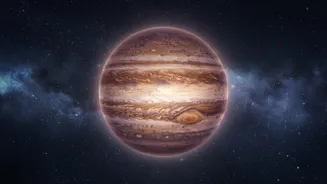
This discovery reinforces that brown dwarfs are not just inert, cooling embers. They are worlds with weather and evolving chemistry. The atmospheric variations suggest they have dynamic systems, possibly with large-scale waves and bands of clouds similar to those seen on Jupiter, but made of different, hotter materials. Understanding this diversity is key. By studying how atmospheric chemistry changes with temperature across many brown dwarfs, scientists can refine their models of how planetary atmospheres, including those of gas giants in other solar systems, behave under different conditions. In essence, these free-floating objects act as a control group for studying super-Jupiters without the blinding glare of a host star. The SPHEREx team has become 'accidental meteorologists' for these strange worlds, paving the way for a more complete census that will include thousands more brown dwarfs found in the mission's all-sky survey.