

What Is Space Weather?
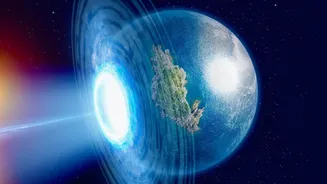
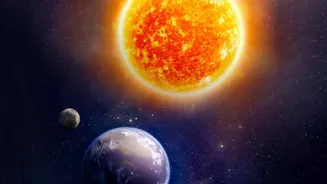
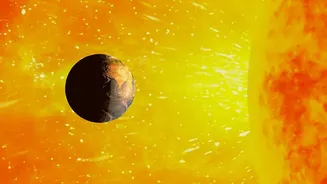
Just like Earth has weather, space has it too. But instead of wind and rain, space weather refers to the changing conditions in space driven by the Sun. It’s a mix of radiation, plasma (super-hot charged particles), and magnetic fields that flow from
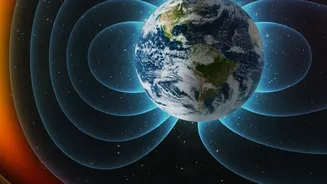
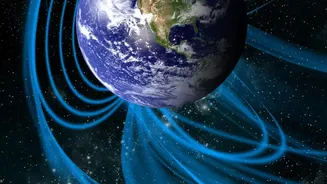
the Sun and travel across the solar system. This constant stream of particles is called the solar wind. While usually harmless to us on the surface, thanks to Earth's protective magnetic field and atmosphere, a 'stormy' day in space can have major consequences for the technology our world depends on.
The Sun’s Fiery Temper
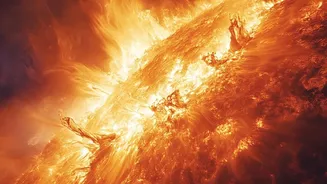
Most of the time, the Sun is a steady source of energy. But its surface is a turbulent place. Sometimes, magnetic energy builds up and is suddenly released in two main ways: solar flares and Coronal Mass Ejections (CMEs). A solar flare is an intense burst of radiation, like a giant flash of lightning, that can disrupt high-frequency radio communications. A CME is even more powerful; it’s a massive cloud of plasma and magnetic fields hurled into space. If Earth is in the path of a CME, it can trigger a 'geomagnetic storm'—a major disturbance of our planet's magnetic field.
Our Technological Achilles' Heel
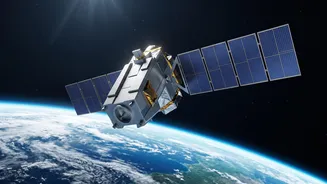
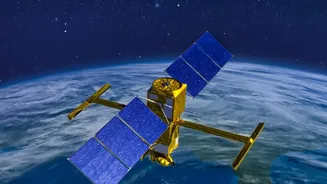
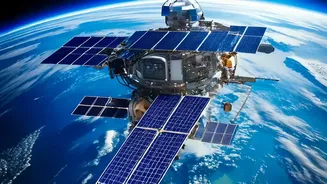
In today's world, we are more vulnerable to space weather than ever. Satellites, which operate outside Earth's protective atmosphere, are on the front line. Intense solar radiation can damage their electronics, cause them to register phantom commands, or even shorten their lifespan. This directly impacts services we use daily. GPS navigation, for example, can become inaccurate or fail completely as solar events disturb the ionosphere, the atmospheric layer that radio signals must pass through. This doesn't just mean your car's navigation might fail; it affects aviation, shipping, and precision agriculture.
Blackouts from 150 Million Kilometres Away
The threat extends to the ground. A strong geomagnetic storm can create powerful electrical currents that flow through the Earth's surface. These currents can find their way into power grids, overloading and damaging critical high-voltage transformers, potentially leading to widespread and long-lasting blackouts. Such an event could cause a cascade of failures, affecting everything from water supply and communications to transport and healthcare. While catastrophic events are rare, the risk is taken very seriously by governments and utility companies worldwide.
India’s Eye on the Sun
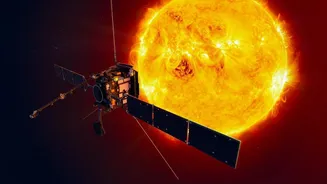
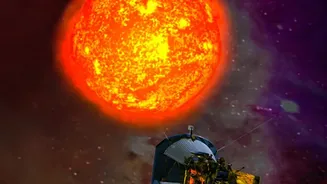
To protect against these threats, we need to forecast space weather. This is where India's Aditya-L1 mission comes in. Launched by ISRO, it is India's first space-based observatory dedicated to studying the Sun. Positioned at a special point 1.5 million km from Earth called the Lagrange point 1 (L1), Aditya-L1 has an uninterrupted view of the Sun. Its seven instruments study the Sun's atmosphere and the solar wind, providing crucial data to understand and predict solar events like CMEs. Better forecasting gives us time to take protective measures, like putting satellites in a safe mode or adjusting power grid operations, helping to safeguard our vital infrastructure.