






The AI Writing Assistant's Double-Edged Sword
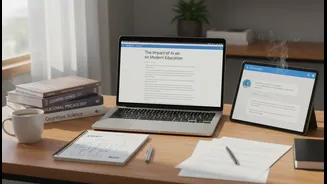
Artificial intelligence tools like Grammarly, ChatGPT, and other online editors have become indispensable for students. They offer instant feedback on grammar, suggest clearer phrasing, and can even help structure an argument. For many, they act as a 24/7
writing tutor, catching embarrassing typos and polishing rough drafts into submission-ready essays. However, this convenience often involves a significant trade-off that many users overlook. When you use most of these popular cloud-based services, the text you type is sent over the internet to the company's servers for analysis. This process is what allows the AI to provide advanced stylistic and grammatical suggestions. The problem is what happens to your data once it leaves your computer.
Why Your Essay Data Is a Big Deal
Treating a public AI tool like a private confidant is risky. Many free writing assistants explicitly state in their privacy policies that they use customer data to train their AI models. This means your unique arguments, unpublished research, or personal reflections could be absorbed into the system and potentially influence future AI-generated content. Beyond training data, there is the risk of security breaches. If the company's servers are compromised, your work could be exposed. For students dealing with sensitive research or simply wanting to protect their intellectual property, uploading drafts to a third-party server creates a genuine privacy concern. You lose control over who sees your work and how it is used.
A New Generation of Offline AI Tools
In response to these privacy concerns, a new category of AI assistants is gaining traction: tools that run entirely on your own device. Often called "offline AI" or "local-first" applications, these programs perform all their processing on your laptop or phone, meaning your data never gets sent to a remote server. The setup typically involves downloading the application and, in some cases, a specific language model. Once installed, the tool works perfectly without an internet connection. This architectural difference is the key to their privacy promise. Everything from a simple grammar check to a full sentence rewrite happens locally, ensuring your papers remain completely private and under your control.
The Practical Benefits of Staying Offline
The most obvious advantage of on-device AI is complete data privacy. Your work stays yours, period. But for students across India, there is another huge benefit: freedom from unreliable internet. Whether you're studying in a library with spotty Wi-Fi, on a train, or in a dorm where the connection drops, offline tools keep working. This removes a major barrier to using AI assistance, making it a more dependable part of the study process. Apps like InnerZero, GPT4All, and various mobile assistants are designed for this exact purpose, offering features for summarising notes, querying documents, and editing text without needing to be online.
What to Look For and What to Expect
When searching for these tools, look for keywords like "offline mode," "on-device processing," or "local AI." Reputable tools will be clear about their privacy architecture. It is important, however, to have realistic expectations. The AI models that run locally are typically smaller and less powerful than the massive, cutting-edge systems used by major cloud services. This means they might not generate poetry or write a complex historical analysis from a single prompt. For the core tasks of a writing assistant — improving clarity, fixing grammatical errors, and rephrasing sentences — they are more than capable. They are powerful editors, not replacement authors.
The Unchanged Importance of the Human Touch
Whether you use an online or offline tool, its role remains the same: it is an assistant, not a substitute for your own thinking. Universities are clear on the distinction between using AI for proofreading versus having it write substantive parts of your paper, which is considered academic misconduct. These tools can help you refine your prose, but the ideas, arguments, and critical analysis must be your own. The final check should always be a human one. Read your work aloud, check that the tone sounds like you, and ensure your arguments are coherent. An AI can polish a sentence, but only you can ensure the integrity of the work as a whole.