



A Marathon of a Milestone
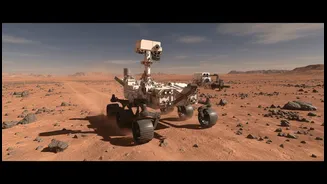
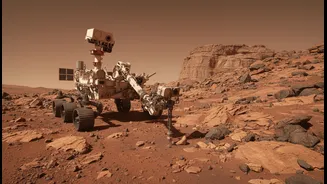
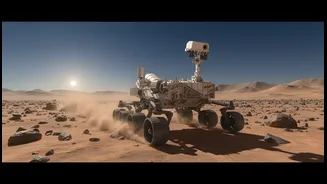
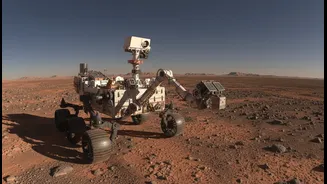
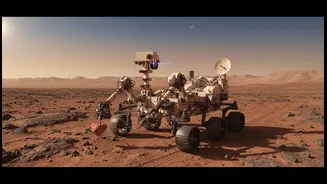
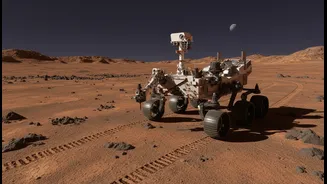
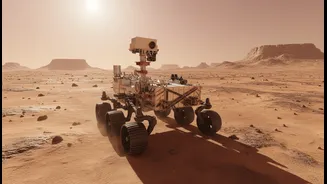
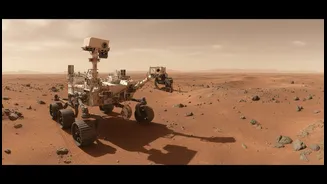
In June 2026, NASA's Perseverance rover officially crossed the marathon mark, having traveled over 42.2 kilometers (26.2 miles) across the unforgiving Martian terrain. This isn't just a symbolic achievement; it’s a testament to the rover’s remarkable
endurance and speed. It reached this milestone in just over five years, less than half the time it took the previous record-holder, the Opportunity rover. While Opportunity’s nearly 15-year journey was legendary, Perseverance is on track to shatter its total distance record in a fraction of the time, a feat made possible by a revolutionary upgrade in its ability to drive itself.
The Need for a Robotic Driver
You can't simply joystick a rover on Mars. Depending on the planets' orbits, the radio signal delay between Earth and Mars can be over 20 minutes each way. If human operators were in direct control, they would issue a command to move forward and wouldn't know for up to 40 minutes if the rover had driven straight into a rock or off a cliff. This communication lag makes real-time control impossible. The solution is to give the rover a brain. Engineers on Earth act as mission planners, setting a final destination, but the rover itself is responsible for navigating the tricky, moment-to-moment decisions of the journey.
Inside AutoNav: The Rover's Brain
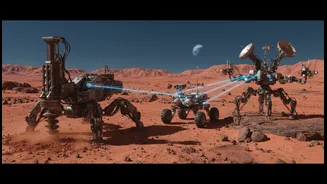
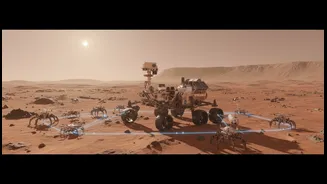
Perseverance’s secret weapon is its advanced autonomous navigation system, called AutoNav. This system uses a pair of stereo navigation cameras to build a 3D map of the terrain in front of it. An onboard computer then analyzes this map, identifying potential hazards like sharp rocks, steep slopes, or patches of soft sand that could trap it. The system assigns a “cost” to different paths, with dangerous routes getting a high score and safe, flat ground getting a low one. It then plots the safest, most efficient path toward its goal. Crucially, Perseverance can do this while its wheels are still turning, a capability called “thinking while driving” that makes it significantly faster than its predecessors like Curiosity, which had to stop, think, and then move.
The Ultimate Safety Net
For a multi-billion dollar asset in an environment where a rescue is impossible, speed must always come second to safety. The loss of the Spirit rover, which became permanently stuck in soft soil, serves as a constant reminder of the risks. Perseverance’s software is built on a foundation of caution. If AutoNav is ever uncertain about the terrain ahead, its default response is to stop. It knows when it doesn't know. While the main navigation system plans the big picture, a separate set of low-mounted hazard cameras constantly scans the ground immediately in front of the wheels, possessing the power to veto any command and halt the rover if an unforeseen obstacle appears. Furthermore, the rover uses a system called visual odometry, constantly comparing images to ensure it hasn't slipped or drifted from its intended path. If the accumulated uncertainty about its exact position becomes too large, it stops and waits for confirmation from Earth, ensuring it never gets truly lost.
Pioneering the Future of Exploration
The advanced autonomy of Perseverance isn't just about setting distance records on this mission; it's a critical technology for all future robotic exploration. Over 90% of the driving on Perseverance is now done autonomously, a huge leap that allows it to cover more ground and spend more time on its primary science mission: searching for signs of ancient life and collecting samples for a potential return to Earth. Every kilometer driven autonomously proves the robustness of a system that can be adapted for future missions to even more challenging and distant worlds. This careful balance of granting a robot greater freedom while programming in strict, non-negotiable safety limits is the key to unlocking the next frontier of our solar system.