







A Titan's Tale
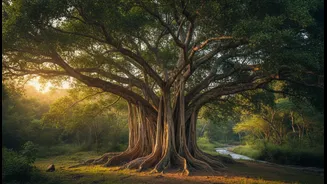
For generations, the people of Munger looked at the colossal banyan tree on the local ITC campus with a sense of awe, assuming it was old. But recent discoveries have turned folklore into fact. Using high-precision radiocarbon dating, scientists from
the Birbal Sahni Institute of Palaeosciences have confirmed the tree is approximately 700 years old, making it the world's oldest scientifically dated banyan. This isn't just a local wonder; it's a living piece of world heritage. Having survived centuries of changing empires, the devastating 1934 earthquake, and countless storms, its existence today is a miracle of resilience. This scientific validation has prompted local authorities to begin the process of declaring it a heritage tree, ensuring its protection for future generations.
More Than Just a Tree
Across India, ancient trees like the Munger banyan are more than just large plants; they are ecological and cultural cornerstones. They function as keystone species, creating entire micro-habitats for birds, insects, and other organisms. With vast root systems, they regulate water cycles and prevent soil erosion, while their massive canopies provide shade and cool the air. Culturally, they are irreplaceable. Many, like the sacred groves in Meghalaya or temple trees in Tamil Nadu, are revered as deities or community centres—the silent, sturdy heart of a village. These trees are living archives, storing centuries of ecological data in their form and genetic makeup, and are often central to local traditions and spiritual beliefs.
A Patchwork of Protection
Despite their immense value, the protection of ancient trees in India is often inconsistent and fragile. While foundational laws like the Indian Forest Act, 1927, and the Biological Diversity Act, 2002, provide a framework, they often focus on forests as a whole, not individual landmark trees, especially those outside protected areas. Several states have their own Tree Preservation Acts, but these vary widely and are often no match for the pressures of urbanisation and infrastructure development. The concept of a “Heritage Tree” is gaining traction, with states like Bihar and Uttar Pradesh identifying and protecting specific trees. However, there is no single, robust national policy, leaving many of these natural monuments vulnerable to being seen as obstacles to progress rather than assets to be preserved.
Lessons from Living Landmarks
India is home to some of the world's most spectacular trees, each with a story. The Great Banyan in Kolkata, over 250 years old, covers several acres, while Thimmamma Marrimanu in Andhra Pradesh is another contender for the world's largest banyan, steeped in local legend. These trees demonstrate the potential for natural heritage tourism and community pride. Yet, for every celebrated tree, countless others are lost. A recent study noted a severe decline in large farmland trees across India, which weakens climate resilience for rural communities. The fight to save these giants often falls to local communities and activists, who face an uphill battle against development projects that view trees as collateral damage.
The Path Forward
The Munger banyan proves that our natural heritage is even richer than we imagined. Its story should be a catalyst for a more unified and proactive national approach. This includes creating a national register of heritage trees, providing them with legal status similar to heritage monuments, a suggestion gaining momentum among activists. A national framework, perhaps modelled on Maharashtra's early legislation, could empower local communities to act as guardians and provide funds for the scientific management and conservation of these living landmarks. Development planning must evolve to integrate these ancient giants, designing projects around them rather than through them. We need to see them not as hindrances, but as invaluable, irreplaceable assets.