


The Slow Descent of a Legend
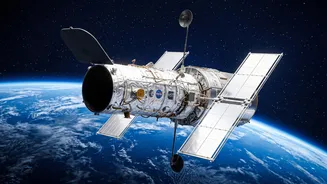
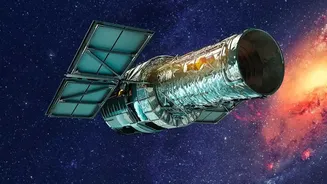
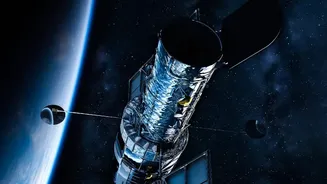
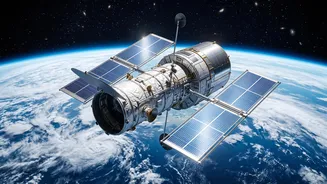
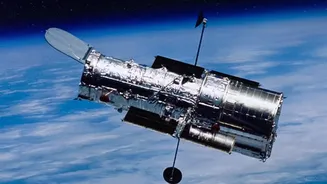
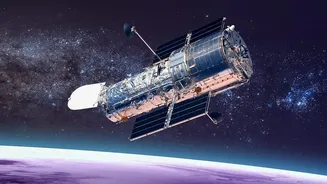
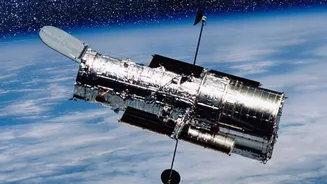
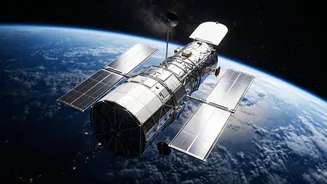
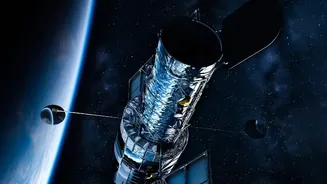
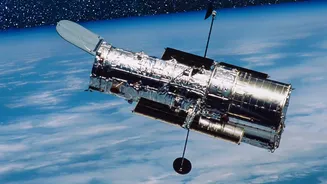
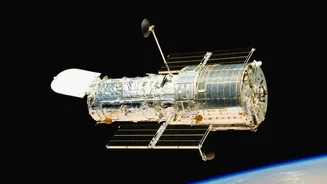
Since its launch in 1990, the Hubble Space Telescope has orbited Earth, capturing images that have redefined our understanding of the universe. However, it has no propulsion system of its own. It relies on its initial altitude to stay in orbit. Over the decades,
faint atmospheric drag has been pulling it down. The last time astronauts on a Space Shuttle mission gave it a boost was in 2002. Now, its orbit, which was once around 600 kilometres, has decayed significantly. As of late 2026, it is estimated to be around 470-480 kilometres and is falling by about 14 kilometres per year. Without intervention, projections show it could make an uncontrolled re-entry into Earth's atmosphere sometime in the mid-2030s.
NASA's Call for Commercial Rescuers
Recognizing the impending end of one of its greatest assets, NASA has turned to the private sector. In late October 2026, the agency issued a formal Request for Information (RFI). This RFI is not a contract, but a way for NASA to gauge the capabilities of commercial space companies to perform a daring rescue. Companies have until November 30, 2026, to submit their ideas. The request outlines three main possibilities: a 'reboost' mission to push Hubble into a higher, more stable orbit; a servicing mission to potentially upgrade its systems; or a mission to guide it to a safe, controlled deorbit over an unpopulated area of the ocean. This approach marks a significant shift, relying on the innovation of the commercial space industry, which has evolved rapidly in recent years.
The High-Stakes Options on the Table
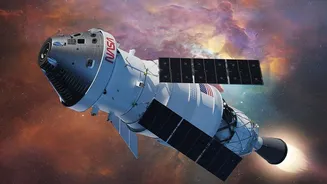
A reboost is the most talked-about option. Pushing Hubble to an orbit of 600 kilometres could add another 15 to 25 years to its operational life. This would involve a commercial spacecraft, possibly a robotic tug or a crewed vehicle like SpaceX's Dragon, rendezvousing with and docking to the telescope. This is a complex maneuver, as Hubble was designed to be serviced by the Space Shuttle, not modern spacecraft. One prominent proposal came from a study by SpaceX and the Polaris Program, funded by billionaire Jared Isaacman, which explored using a Dragon capsule for this purpose. While that specific plan was not pursued at the time, the new RFI opens the door for that and other innovative solutions from the broader industry. Any mission would be technically challenging and carry risks to the delicate observatory.
Why Hubble Is Still Worth Saving
With the newer, more powerful James Webb Space Telescope (JWST) now in operation, some may wonder why we still need Hubble. The answer is that they are complementary, not competitors. JWST is designed to see the universe primarily in infrared light, allowing it to peer through dust clouds and see the earliest galaxies. Hubble, on the other hand, is a master of visible and ultraviolet light. It provides a different, but equally crucial, view of the cosmos, studying everything from planets in our solar system to the atmospheres of distant exoplanets. Scientists say that Hubble's unique capabilities will not be replaced until at least the 2040s with the launch of the planned Habitable Worlds Observatory. Losing Hubble would mean losing a vital window on the universe for more than a decade. Astronomer demand for using Hubble remains incredibly high, with requests for observing time far exceeding what is available.