


Scattered throughout our galaxy are mysterious objects neither star nor planet. A new study from NASA's SPHEREx telescope is pulling back the curtain on these 'failed stars', revealing a surprisingly diverse and complex atmospheric story.
Meet the 'Failed Stars' of the Cosmos
Imagine a star
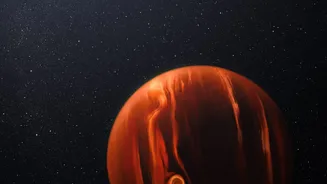
that never quite made it. That's a brown dwarf. These celestial objects form just like stars do, from the gravitational collapse of a giant cloud of gas and dust. But they never accumulate enough mass—falling somewhere between 13 and 80 times the mass of Jupiter—to ignite the sustained nuclear fusion of hydrogen in their cores, the process that makes stars like our sun shine brightly for billions of years. Instead of becoming brilliant beacons, they are left as dimly glowing balls of gas, slowly cooling over eternity. This 'failure' makes them incredibly intriguing, offering a unique window into the processes that govern both star and planet formation.
A New Infrared Eye on the Universe
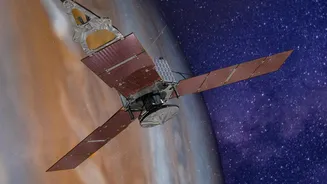
Observing these dim worlds is a challenge, as they emit very little visible light, glowing mostly in the infrared spectrum. This is where NASA's SPHEREx (Spectro-Photometer for the History of the Universe, Epoch of Reionization, and Ices Explorer) comes in. Launched in March 2025, this space telescope is on a mission to map the entire sky in infrared light, a feat it accomplishes by taking thousands of images daily. By measuring the brightness of objects across 102 different colors of infrared light, SPHEREx creates a detailed spectrum for each one. This spectrum acts like a chemical fingerprint, allowing scientists to identify the molecules present in the atmospheres of distant objects, something impossible to do from the ground where Earth's own atmosphere blocks much of this light.
A Menagerie of Mysterious Atmospheres
The latest study, published in The Astrophysical Journal, used SPHEREx to analyze 37 nearby brown dwarfs across a vast temperature range, from a fiery 2,200 degrees Celsius down to a frigid minus 20 degrees Celsius. The results revealed chemically rich atmospheres containing water, carbon monoxide, carbon dioxide, and methane. More surprisingly, the study showed that even at the same temperature, no two brown dwarfs are exactly alike; their atmospheric compositions can be distinctly different. As lead author Zafar Rustamkulov noted, these free-floating objects are more complex than previously understood, with each one telling a slightly different story.
Challenging the Models of Cloud Formation
The key finding relates to how their 'clouds'—not of water, but of exotic materials like silicates or even molten iron at hotter temperatures—behave as the brown dwarf ages and cools. The data shows a clear transition: as a brown dwarf cools, its thick clouds eventually thin out, allowing gases like methane to become dominant features in the atmosphere. While current atmospheric models can predict the general chemical trends, they struggle to accurately replicate this cloudy transition phase observed by SPHEREx. The diversity seen from one brown dwarf to the next suggests that factors beyond just temperature are at play, turning astronomers into what coauthor J. Davy Kirkpatrick calls 'accidental meteorologists'.
Why These Goth Stars Matter
Studying brown dwarfs isn't just about understanding these specific objects. Because they are untethered to a bright host star, their atmospheres are much easier to analyze than those of exoplanets, which are often blinded by their sun's glare. This makes brown dwarfs a perfect natural laboratory for understanding the atmospheric physics of gas giants like Jupiter and Saturn. By analyzing a huge population of these failed stars, which is a secondary goal for the SPHEREx mission, scientists can refine their models of how atmospheres and clouds form across a wide range of temperatures and conditions. This knowledge ultimately helps us piece together the grand narrative of how planetary systems, including our own, come to be.