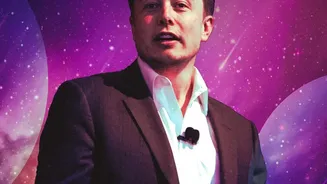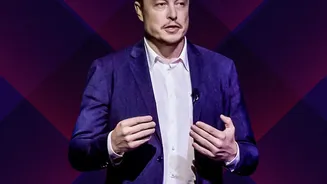





Elon Musk is once again pointing to the stars, this time for the future of artificial intelligence. His latest remarks suggest moving massive data centres into orbit, a sci-fi vision that sidesteps Earth's limits but runs into major questions.
What is Space-Based AI?
The concept
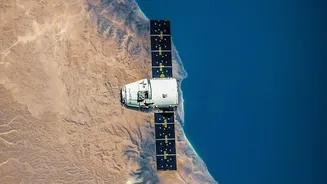
of a space-based data centre is simple in theory but complex in practice. Instead of building sprawling, power-hungry facilities on land, the idea is to place servers and other computing hardware into orbit. These orbital data centres would draw on near-continuous solar power and process vast amounts of data in space. The primary motivation is to overcome growing constraints on Earth, where building new AI infrastructure faces challenges related to grid capacity, access to cooling water, and local opposition. Proponents argue that space offers unlimited solar energy and a vacuum that can act as a giant, free heat sink. Companies like Google, with its Project Suncatcher, and Axiom Space are already exploring this frontier, aiming to create constellations of satellites that function as a distributed computing network. This would be particularly useful for processing data collected in space, such as from Earth-observation satellites, reducing the need to send massive datasets back to the ground.
Musk’s Orbital Ambition
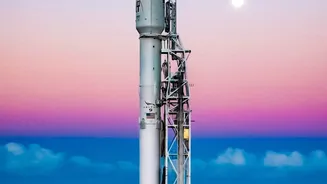
Elon Musk's recent comments, particularly a post on X stating that 'Data centers in space looking pretty appealing right now', have renewed focus on this futuristic concept. His remarks came in early November 2026, following US midterm election results that saw support for measures restricting terrestrial data centre construction. For Musk, this isn't a new idea but an acceleration of a long-term strategy. He has previously stated that within a few years, space could become the most cost-effective place for AI compute. This vision is tied to the vertical integration of his companies. SpaceX's Starship is designed to dramatically lower launch costs, while its Starlink satellite network provides the blueprint for a high-speed optical communication mesh between orbital nodes. Following the integration of his AI firm, xAI, into SpaceX, the company has reportedly filed for a constellation named 'Starmind' and is scaling up satellite manufacturing, signalling a concrete push towards this goal.
The Sobering Engineering Hurdles
Despite the grand vision, moving data centres into orbit presents a formidable list of engineering challenges that remain largely unsolved. The primary obstacle is thermodynamics. While the vacuum of space is cold, it is not an efficient coolant because there is no air for convection. Heat generated by powerful processors must be radiated away, which requires large, heavy panels, adding to launch mass and cost. Another major issue is radiation. Space is filled with high-energy particles that can corrupt data and degrade electronic hardware, necessitating expensive and heavy shielding or specialized, radiation-hardened components. Other critical problems include generating and storing enough power to run AI accelerators continuously, ensuring reliable high-speed networking between thousands of satellites, and the impossibility of performing handson repairs. Furthermore, launching the sheer mass of hardware required is economically challenging, with success dependent on radically cheaper launch costs.
What's the Next Step?
The path forward is incremental, starting with smaller scale test missions. Google's Suncatcher project, for example, launched a test satellite in late October 2026 to study the feasibility of the concept, though it faces significant power limitations. SpaceX is reportedly targeting the fourth quarter of 2027 for its first dedicated orbital data centre demonstration payload, which will test high density AI accelerators and optical communication links in a low Earth orbit. These early missions are not designed to replace terrestrial data centres overnight but to answer fundamental questions about thermal management, radiation resilience, and the unit economics of orbital computing. The success of these initial steps will determine whether space based AI can move from a theoretical solution to a practical, large scale infrastructure. The journey is long, but the ambition is clear: to build the next generation of AI not on land, but among the stars.