



Nature's Unwitting Laboratories
In the world of climate science, models are our best glimpse into the future. These complex simulations are built on our understanding of physics and chemistry, tested against historical data. But they have a limitation: they are rarely tested by events
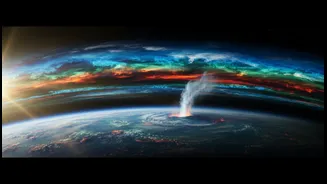
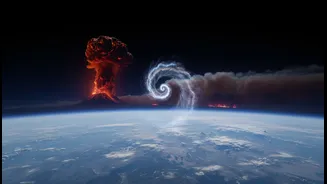
of an extreme scale. This is where wildfires and volcanoes unexpectedly come in. By injecting massive, unprecedented amounts of smoke, ash, and gases into the stratosphere, these events provide a real-world stress test for climate models. Scientists get a rare opportunity to see if their theories hold up when pushed to the limit, revealing both the strengths and weaknesses of their predictive tools.
When Wildfires Create Their Own Weather
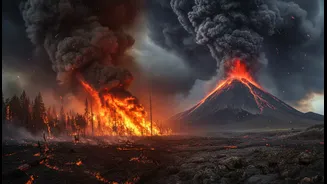
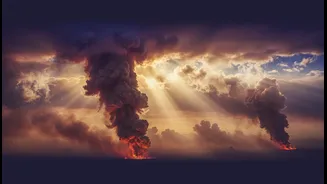
Mega-fires, like the Australian 'Black Summer' of 2019-2020, do more than just burn across the landscape; they create their own weather. The intense heat generates enormous pyrocumulonimbus clouds—fire-driven thunderstorms—that can punch smoke directly into the stratosphere, an atmospheric layer that typically sits calmly above the weather of the troposphere below. The Australian fires injected more smoke into the stratosphere than any previously recorded event, creating a natural laboratory. Researchers discovered that chemicals on the surface of these smoke particles triggered reactions that depleted ozone, revealing a gap in our understanding of atmospheric chemistry. These observations force scientists to update their models to include chemical pathways they had not previously considered significant.
Volcanoes: More Than Just Ash and Dust
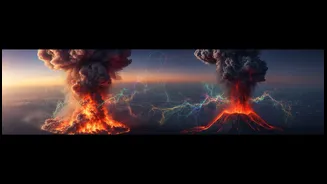
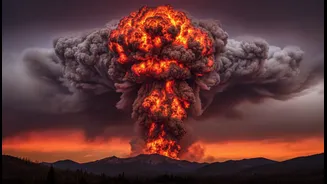
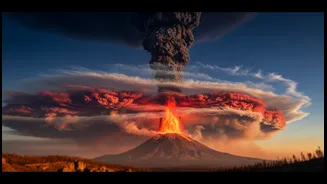
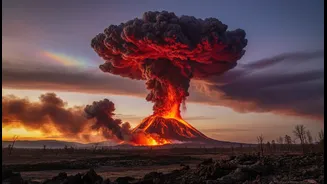
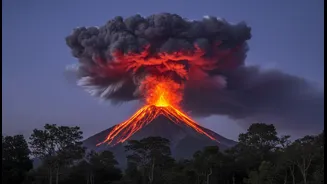
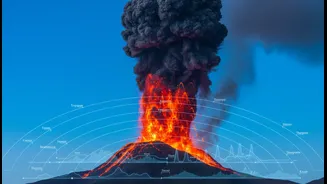
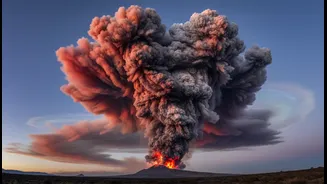
Volcanoes have long been known to affect climate, primarily by injecting sulfur dioxide that forms sunlight-reflecting aerosols, leading to temporary cooling. However, the 2022 eruption of the Hunga Tonga-Hunga Ha’apai submarine volcano was different. It blasted a record-breaking amount of water vapour—a potent greenhouse gas—into the stratosphere, alongside a relatively smaller amount of sulfur. This unique event gave scientists a chance to study the warming effect of stratospheric water vapour in isolation, a crucial factor for long-term climate estimates. The data is helping to disentangle the competing warming and cooling effects of different types of volcanic emissions, which vary greatly from one eruption to the next.
Sharpening Our Gaze into the Future
The data from these extreme natural events is invaluable for improving forecast confidence. When a model successfully predicts the atmospheric changes following a volcanic eruption or wildfire, it increases scientists' trust in that model's ability to forecast future climate change. Conversely, when the model fails, it's even more useful. It points directly to areas where the science is incomplete, guiding future research. For example, some models struggled to replicate the precise chemical changes seen after the Australian fires, prompting urgent new laboratory studies on smoke particle chemistry. By incorporating more realistic volcanic scenarios and newly discovered chemical reactions, scientists can build more robust and reliable climate projections.
A Crucial Lesson in Humility
This brings us to the most important part of the headline: avoiding overstated certainty. These events don't make climate science simpler; they reveal its profound complexity. The surprising effects of wildfire smoke on ozone and the unexpected cooling from the Hunga Tonga eruption (due to the way water vapour altered aerosol formation) are powerful reminders of how much there is still to learn. Rather than providing a definitive answer, they add crucial new questions and sources of uncertainty that models must now account for. The goal is not to achieve perfect, absolute certainty, which is impossible in a system as complex as Earth's climate. Instead, the goal is to honestly quantify that uncertainty, making scientific projections more credible, not less.