




Meet the 'Warm Neptunes'
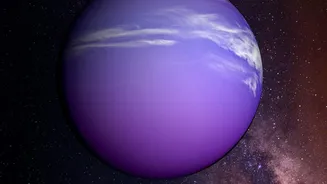
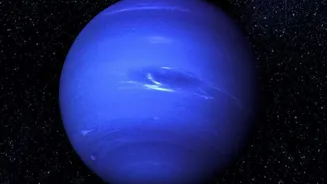
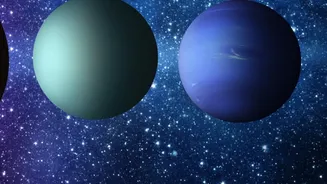
Imagine a planet roughly the size of Neptune in our own solar system, but snuggled much closer to its host star. These are the worlds astronomers have dubbed 'warm Neptunes'. They are a common type of exoplanet, yet they present a significant puzzle because
they don't exist in our solar system. These planets occupy a middle ground—larger than rocky Earth but smaller than gas giants like Jupiter. Due to their proximity to their stars, they receive significant radiation, making their atmospheres hot, but not scorching enough to be classified as 'hot Jupiters'. This unique temperature range is where the mystery begins. According to established theories, these planets should have a hard time holding onto certain gases, especially one as fragile as methane.
The Methane Puzzle
Methane is a relatively simple molecule, but its presence on a warm Neptune is a big deal. The conventional wisdom was that the intense ultraviolet radiation from a nearby star would quickly break down any methane in a planet's upper atmosphere. This process, known as photochemistry, should scrub the skies clean of methane, leaving behind other compounds. For a long time, observations seemed to support this; methane was notoriously difficult to detect on these transiting exoplanets. Scientists expected to find atmospheres dominated by other molecules, believing methane couldn't survive the stellar bombardment for long without a way to be continuously replenished. The apparent absence of methane was a key piece of the puzzle in understanding the lifecycle and atmospheric dynamics of these worlds.
A Surprise in the Skies
Enter the James Webb Space Telescope (JWST). With its unprecedented sensitivity, JWST has begun to systematically peel back the layers of exoplanet atmospheres, and its findings are revolutionary. On a warm Neptune called WASP-107b, a planet so low in density it's often called 'puffy' or 'cotton-candy-like', JWST detected the clear signature of methane. This was a shock. The amount was small—about 1,000 times less than what chemical equilibrium models predicted—but it was undeniably there. Its existence flew in the face of the idea that photochemistry would destroy it all. Finding methane meant something was actively supplying it to the atmosphere, challenging the long-held belief that such planets would be methane-poor.
A Planet's Inner Life
The discovery of methane on WASP-107b has pointed scientists toward a new theory. Instead of being a static world with an atmosphere slowly being eroded by its star, the planet must have a dynamic interior. The new leading hypothesis is that WASP-107b has a surprisingly hot interior and a much more massive core than previously thought. This internal heat source creates vigorous vertical mixing in the atmosphere, like a powerful convection current. This process dredges up methane from deep within the planet's envelope and pushes it into the upper atmosphere faster than the star's radiation can destroy it. This suggests the planet is not just a passive victim of its environment but an active world with a churning, hot interior that constantly refreshes its own skies. This internal heating may also be what causes the planet to be so 'puffy'.
Redrawing the Planetary Map
This single discovery has profound implications for our understanding of planetary evolution. It suggests that a planet's lifespan and atmospheric composition are not just dictated by its distance from its star, but also by its internal engine. The findings for WASP-107b suggest that many warm Neptunes may have massive cores and hot interiors, which helps resolve a tension with core-accretion models of planet formation. It provides a mechanism to explain the inflated radii of many low-density exoplanets, a long-standing mystery. Essentially, astronomers are learning that to understand what's on the outside of an exoplanet, you have to understand what's happening deep inside. The presence of methane is no longer just a chemical curiosity; it's a tracer that reveals the hidden life of a planet's core and its ongoing geological activity.