

A Paradox at the Heart of the Sun
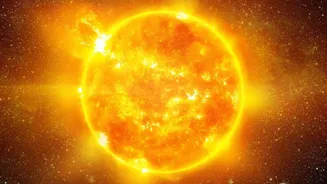
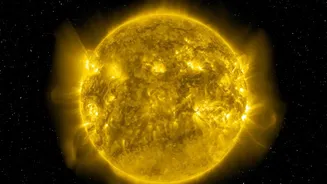
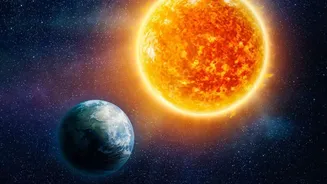
Imagine standing by a bonfire and feeling hotter the further you move away. It defies logic, yet something similar happens with our sun. Its visible surface, the photosphere, burns at a formidable 5,500 degrees Celsius. But its wispy outer atmosphere,
the corona, which is visible during a total solar eclipse, sizzles at an astonishing 1 to 2 million degrees Celsius. This phenomenon, known as the coronal heating problem, has puzzled astrophysicists since the 1940s. The basic laws of thermodynamics suggest the corona should be cooler than the surface, not hundreds of times hotter. For decades, scientists have theorized that some mechanism must be transporting energy from the sun's interior and dumping it into the corona, but the exact process has remained a mystery.
Unprecedented Images Reveal Swirling Vortices
The latest clue comes from the Daniel K. Inouye Solar Telescope in Hawaii, the world's most powerful solar observatory. In results announced in early August 2026, scientists revealed the highest-resolution images ever taken of the sun's surface. These remarkable images show swirling, wave-shaped vortices of plasma that were too small to see until now. Identified as a phenomenon called Kelvin-Helmholtz instabilities, these patterns form when fast-moving plasma slides past slower-moving plasma, creating a shear that spirals into a vortex. You can see similar patterns on Earth when wind blows over water, or in the cloud bands of Jupiter. On the sun, these newly seen whirlpools are believed to be a key part of the energy transfer puzzle.
The Missing Link: From Surface to Corona
Scientists believe these small-scale vortices play a large-scale role. As these plasma whirlpools churn on the sun’s surface, they twist and shuffle the powerful magnetic field lines that loop out into the corona. This constant twisting motion essentially injects magnetic energy into the atmosphere. This energy travels upwards along the magnetic field lines in the form of waves. For years, researchers theorized that so-called Alfvén waves could be responsible for heating the corona, but previous observations only found slow-moving waves that didn't carry enough energy. However, recent findings, including others from the Solar Orbiter spacecraft, have identified high-frequency waves that seem to carry a substantial amount of energy. The newly observed vortices are seen as a powerful engine for creating these very waves, providing a crucial link between the motions on the surface and the extreme heat millions of kilometres above.
A Wave of New Discoveries
The discovery of these surface vortices is part of a wave of recent breakthroughs. Other research, using both laboratory experiments and satellite observations, has bolstered the wave heating theory. A study led by researchers at the Princeton Plasma Physics Laboratory experimentally demonstrated that as these plasma waves, called Alfvén waves, travel up into the corona, they can reflect off changing plasma densities and collide, creating turbulence that generates immense heat. Another team using data from Europe's Solar Orbiter recently detected abundant high-frequency waves in the sun's polar regions, providing further evidence that these waves carry enough energy to heat the corona and power the solar wind, the stream of charged particles flowing from the sun.
Why Solving This Mystery Matters
Understanding the coronal heating problem is more than just solving an academic puzzle. The same mechanics that heat the corona also drive space weather, including solar flares and coronal mass ejections. These massive eruptions of energy and plasma can travel to Earth, where they can disrupt satellites, endanger astronauts, and even knock out power grids. By understanding the fundamental physics of the sun's atmosphere, scientists can improve their models and better predict these potentially damaging events. As one scientist noted, these discoveries mark a major step forward in understanding the dynamics of solar plasma and will serve as a foundation for future breakthroughs in forecasting space weather.