


A Celestial Marvel in 1604
When the mysterious star blazed into existence in the constellation Ophiuchus, it caused a sensation across Europe and Asia. For a generation that held the heavens to be perfect and unchanging, its appearance was a profound challenge to ancient beliefs.
Johannes Kepler, a German astronomer, was not the first to see it, but he studied it so meticulously for over a year that it became known as Kepler's Supernova. He tracked its brightness and position with naked-eye observations, as the telescope had not yet been turned to the sky. His detailed work, 'De Stella Nova' ('On the New Star'), documented a celestial event that we now understand was not a beginning, but a spectacular and violent end.
The Anatomy of a Supernova
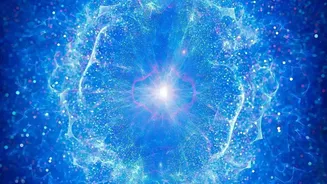
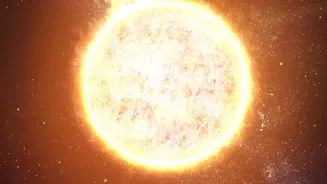
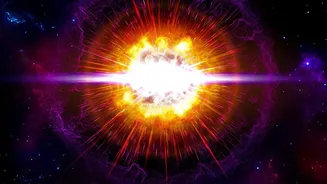
So, what did Kepler actually see? Modern astronomy classifies SN 1604 as a Type Ia supernova. This isn't the birth of a star, but the death of one. A supernova is one of the most powerful explosions in the universe. A Type Ia event occurs in a binary star system, where two stars orbit each other. One of these stars is a white dwarf—a small, dense, dead star. Over time, the white dwarf's powerful gravity can pull material away from its companion star. When the white dwarf accumulates too much mass, it reaches a critical point called the Chandrasekhar limit. This triggers a runaway thermonuclear reaction that completely obliterates the star in a brilliant flash, briefly outshining entire galaxies.
The True Meaning of a 'New Star'
The term 'stella nova' created lasting confusion. If a supernova is a death, what is a 'new' star? In astronomy, new stars are born, but not in a flash. They form slowly over millions of years inside vast, cold clouds of gas and dust called nebulae. Gravity causes clumps of this material to collapse inward, heating up and forming a protostar. This process is a gradual gathering, not a violent explosion. The term 'nova' is also used today, but it describes something far less dramatic than a supernova. A nova is a temporary, intense brightening of a white dwarf, also in a binary system. Like in a supernova, it pulls gas from a companion, but it only causes a powerful explosion on its surface. The star itself survives and can even experience more nova events in the future. A supernova is a one-time, terminal event.
From Historical Puzzle to Modern Science
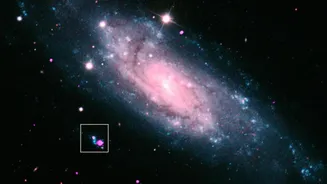
Kepler's Supernova of 1604 was the last supernova observed within our own Milky Way galaxy. While others have been seen in distant galaxies, this event gave us a relatively close-up view. Today, astronomers use powerful telescopes to study its aftermath—an expanding shell of gas and dust known as Kepler's supernova remnant. By analyzing the elements forged in the explosion and the speed at which the remnant is expanding, scientists can reconstruct the event. These cosmic blasts are not just destructive; they are fundamentally creative. Supernovae scatter heavy elements like iron across the galaxy, which are essential for forming new stars, planets, and even life. The iron in your blood was forged in the heart of an exploding star long ago.