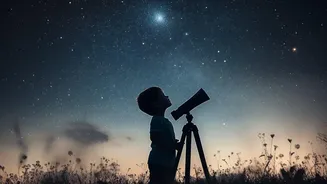


Why You Don't Need a Telescope (Yet)
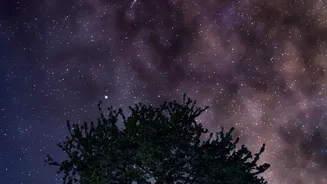
The biggest myth preventing people from starting astronomy is the belief that you need a powerful and expensive telescope. In reality, some of the most rewarding sights are visible with the naked eye or simple binoculars. Planets, meteor showers, and the majestic
band of the Milky Way don't require high magnification. Starting without a telescope forces you to learn the fundamentals: the layout of the constellations, the movement of the planets, and the rhythm of the seasons. This foundational knowledge is invaluable. Many seasoned astronomers spend years observing with binoculars before ever considering a telescope, and some prefer them for their wide, immersive views. The goal is to get started, not to get overwhelmed by complex equipment. A clear sky and a bit of curiosity are your most important tools.
Your First Essential: A Sky Map App
Your smartphone is a powerful planetarium. A good sky map app is the single most essential tool for a beginner. When you point your phone at the sky, these apps use your location and internal sensors to show you exactly what you're looking at, identifying stars, constellations, and planets in real-time. For Indian users, apps like Stellarium, SkyView, and Star Walk 2 are excellent starting points, available on both Android and iOS. They allow you to search for a specific planet, and an arrow will guide you to its position in the sky. Many have a red-light mode, which preserves your night vision—a crucial feature for any stargazer. There's even an Indian-made app called Bhagol that overlays traditional Indian nakshatras and rashis onto the sky, offering a unique cultural perspective. Simply download an app, head to a rooftop or balcony, and start identifying the bright dots above you.
Your Second Essential: A Stable Tripod
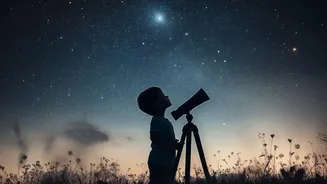
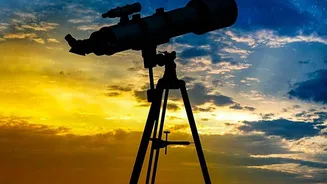
While it might seem basic, a stable tripod is the game-changer mentioned in the headline. Its primary job is to eliminate the natural shakiness of your hands, which becomes very noticeable when you're trying to focus on a distant point of light. This is especially true if you decide to use binoculars, which are the logical next step up from naked-eye viewing. Even a 10x magnification binocular is difficult to hold steady for long periods. Mounting them on a tripod provides a rock-solid, comfortable viewing experience, allowing you to study objects in detail without your arms getting tired. When choosing a tripod, prioritise sturdiness over portability. You need something that won't wobble in a light breeze. A smooth head that allows for easy panning across the sky is also a major benefit for tracking objects as they move.
Finding Your First Planets
The five 'bright' planets—Mercury, Venus, Mars, Jupiter, and Saturn—have been watched by humans for millennia and are all visible from India without a telescope. A key tip for beginners is that planets tend to shine with a steady light, while stars twinkle. Using your sky map app, you can easily find out which planets are currently visible. For instance, in late 2026, Saturn is a highlight, reaching its brightest point in early October and remaining visible all night. Jupiter is often the second-brightest object after Venus and is a brilliant sight. With a pair of binoculars on your tripod, you can even glimpse Jupiter’s four largest moons, appearing as tiny pinpricks of light lined up beside the planet. Seeing the moons of another world with your own eyes is an unforgettable experience and perfectly achievable for a beginner.
Tips for Your First Viewing Night
To make your first stargazing session a success, a little preparation goes a long way. First, try to get away from direct city lights. While planets are bright enough to be seen from a city, escaping to a darker location even a short drive away will reveal thousands more stars. Second, plan your session around the new moon. A bright full moon acts like natural light pollution, washing out fainter objects. Third, and most importantly, give your eyes time to adapt. It takes about 20-30 minutes of complete darkness for your eyes to reach their full sensitivity. Avoid looking at your phone screen (unless it's in red-light mode) or any other white light, as it will reset your night vision instantly. Finally, be patient. Astronomy is a hobby of slow, quiet discovery. The more you look, the more you will see.