



A Violent, Lifeless Beginning
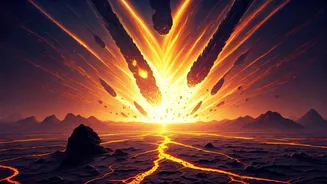
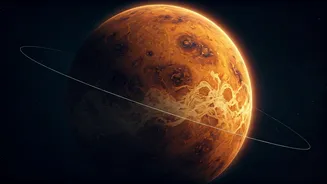
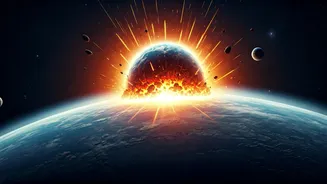
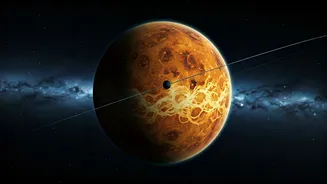
In its infancy, during a period known as the Hadean Eon, Earth was anything but hospitable. It was a hellscape, constantly bombarded by space debris, with a surface of molten lava and an atmosphere thick with toxic gases. The intense heat and pressure
during the planet's formation had a crucial side effect: heavy elements like iron and nickel sank to the centre, forming the core. This process, known as differentiation, was great for creating our protective magnetic field, but it was terrible for life’s prospects. It dragged many of the lighter, essential ingredients for life down with it, locking them away deep inside the planet.
The Missing Ingredients for Life
Life as we know it is built from a few key elements, primarily carbon, hydrogen, nitrogen, oxygen, phosphorus, and sulphur. Scientists refer to elements like carbon and nitrogen as ‘volatiles’ because they tend to become gases at relatively low temperatures. When Earth formed, most of its original budget of these volatiles was either burned off by the sun, blasted away into space, or trapped in the planet’s metallic core. Without a significant supply of these elements on the surface—especially carbon and nitrogen, the backbones of amino acids and DNA—the primordial soup would have been far too thin to cook up the first living organisms. Earth was a barren rock, missing the fundamental recipe for biology.
A Cosmic Delivery Service
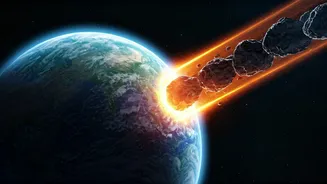
This is where the asteroids come in. For decades, scientists have hypothesised that a 'late veneer' of material arrived after Earth’s core had already formed. Recent studies, including sophisticated lab experiments simulating planetary interiors, add weight to this idea. The theory suggests that after the main phase of planet formation, Earth was repeatedly struck by smaller bodies from the outer solar system—asteroids known as carbonaceous chondrites. These weren't just destructive impacts; they were deliveries. Rich in water, carbon, and nitrogen, these cosmic wanderers essentially re-seeded Earth's surface with the very volatiles it had lost. One dramatic theory even posits that a collision with a Mars-sized planet—the same impact thought to have created our Moon—could have delivered the bulk of Earth's nitrogen in one cataclysmic event.
Clues Written in Meteorites
How can we be so sure about events that happened billions of years ago? The evidence lies in the messengers that still arrive today: meteorites. By studying the chemical composition of carbonaceous chondrites that have fallen to Earth, scientists find that their isotopic signatures—a kind of chemical fingerprint—closely match the ratio of volatiles found in Earth's mantle, atmosphere, and oceans. They are, in essence, leftover building blocks from that ancient delivery service. Furthermore, computer models simulating the chaos of the early solar system show that such collisions were not just possible, but probable. These simulations, combined with the physical evidence from meteorites, create a compelling case for life’s ingredients arriving from outer space.
Rethinking the Search for Alien Life
This theory does more than just rewrite our own planet’s history; it fundamentally changes how we search for life elsewhere in the universe. It suggests that a planet being in the ‘Goldilocks Zone’—the right distance from its star for liquid water to exist—might not be enough. A truly habitable planet might also need a lucky history of impacts to supply it with the necessary biological building blocks. It implies that a stable, quiet solar system might be less likely to host life than a more chaotic one with a history of cosmic collisions. When we look at distant exoplanets, we may need to ask not only if they have water, but also whether they had the right kind of violent, creative past.