

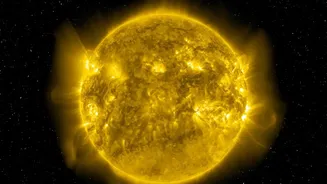
India's Unblinking Eye on the Sun
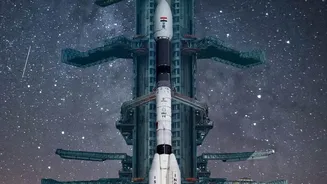
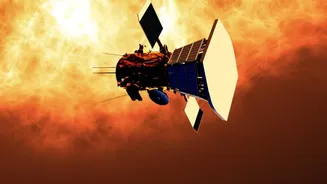
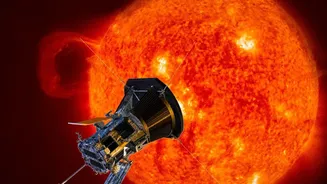
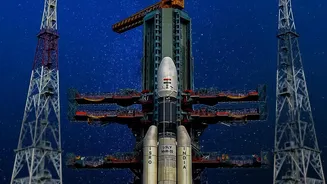
Since its launch on September 2, 2023, the Aditya-L1 mission has marked a new chapter for the Indian Space Research Organisation (ISRO) and global solar physics. Positioned 1.5 million kilometres from Earth at the first Lagrange point (L1), the spacecraft
has an uninterrupted view of the Sun. This unique vantage point allows its seven sophisticated payloads to continuously monitor solar activities without the interference of eclipses. The mission's primary goals are ambitious: to understand the dynamics of the Sun's upper atmosphere, unravel the physics of its immense heat, and study the origins of space weather, including phenomena like Coronal Mass Ejections (CMEs). After reaching its operational orbit in January 2024, Aditya-L1's instruments have been diligently collecting data, offering scientists an unprecedented look at our star.
Solving the Corona's Hottest Mystery
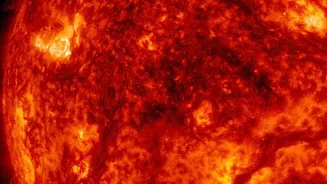
One of the longest-standing puzzles in astrophysics is why the Sun’s corona, its outer atmosphere, is millions of degrees hotter than its visible surface. The surface, or photosphere, simmers at about 5,500 degrees Celsius, while the corona can reach a staggering 2 million degrees. Recent findings from Aditya-L1, published in the Astrophysical Journal Letters, provide compelling new clues. Data from the Visible Emission Line Coronagraph (VELC) suggests that the constant reconfiguration and reconnection of the Sun’s magnetic fields could be the primary engine driving this intense heat. According to a study led by Professor R. Ramesh of the Indian Institute of Astrophysics, this magnetic activity may account for as much as 93% of the energy required to heat the corona, fundamentally changing our understanding of the Sun's energy dynamics.
What Are Solar Storms?
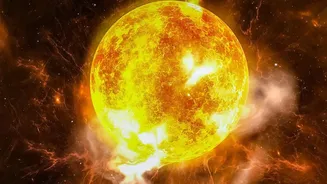
Solar storms are powerful eruptions of energy and matter from the Sun. The most significant of these are solar flares and Coronal Mass Ejections (CMEs). A CME is a massive explosion that hurls billions of tonnes of plasma and magnetic fields into space at incredible speeds. When directed at Earth, these storms can have serious consequences. They can disrupt our planet's magnetic field, creating geomagnetic storms that threaten crucial infrastructure. Satellites, GPS navigation, communication systems, and even terrestrial power grids are all vulnerable to the effects of severe space weather. As our reliance on this technology grows, the ability to forecast these solar events becomes increasingly critical.
A Breakthrough in Space Weather Forecasting
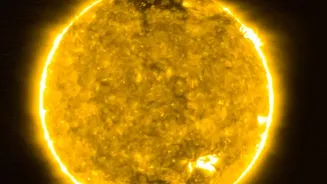
While Aditya-L1 is a solar physics mission, not a dedicated weather satellite, its data is a game-changer for space weather prediction. By observing the Sun in wavelengths that were previously under-observed, such as the near-ultraviolet (NUV) spectrum captured by the Solar Ultraviolet Imaging Telescope (SUIT), the mission provides unique insights. These instruments can detect the subtle precursors to major solar events. For example, researchers have identified tiny bursts of energy that occur before a large flare, similar to small tremors before an earthquake. By studying the characteristics of CMEs as they erupt—including their temperature and energy—scientists can better assess the potential impact if one is heading our way. This information is vital for providing advance warnings, allowing operators to protect vulnerable satellites and power grids from the full force of a geomagnetic storm.
A Major Leap for India and the World
The data streaming from Aditya-L1 represents a significant leap for India’s scientific and space capabilities. The findings not only contribute vital knowledge to the global scientific community but also bolster India’s own capabilities in protecting its growing network of satellites and ground-based infrastructure. ISRO has made it clear that the mission's data will be shared globally, enhancing international efforts to understand and predict space weather. With the Sun approaching its period of maximum activity in 2026, Aditya-L1 is perfectly placed to capture the expected increase in solar storms, providing a front-row seat to the Sun’s most turbulent behaviour and further solidifying India's role as a key player in space science.