






A New Look at Cosmic Neighbours
In a revealing new study, scientists using the SPHEREx space telescope have peered into the atmospheres of dozens of nearby 'dim cosmic objects' known as brown dwarfs. These objects, which float freely in space, were found to have chemically rich atmospheres containing
molecules like water, methane, carbon monoxide, and carbon dioxide. The findings, based on an initial sample of 37 brown dwarfs, show that these worlds are far from simple, exhibiting a wide range of atmospheric properties across different temperatures. This initial data challenges existing models of how these atmospheres should behave, suggesting that our understanding of these celestial bodies is about to undergo a significant revision.
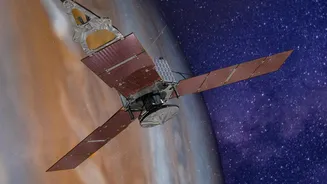
What is SPHEREx?
SPHEREx, which stands for Spectro-Photometer for the History of the Universe, Epoch of Reionization, and Ices Explorer, is a unique space observatory launched in March 2025. Unlike telescopes that focus on a small patch of sky, SPHEREx is designed to scan the entire sky every six months. Its powerful instrument acts like a cosmic prism, breaking down the near-infrared light from every point in the sky into 102 different 'colours' or wavelengths. This technique, known as spectroscopy, allows scientists to create a massive 3D map of the cosmos and identify the chemical fingerprints of molecules in distant stars, galaxies, and, as we're now seeing, brown dwarfs. It's an unprecedented mission to chart the building blocks of the universe on a grand scale.
The Universe's Middle Children
The 'dim cosmic objects' in the headline are brown dwarfs, fascinating bodies that occupy a grey area between planets and stars. They form from collapsing clouds of gas, just like stars, but they never accumulate enough mass—falling short of the roughly 80-times-Jupiter-mass threshold—to ignite sustained hydrogen fusion in their cores. Because of this, they are often called 'failed stars'. They are more massive than planets like Jupiter but don't shine brightly like the Sun, instead glowing dimly from their own internal heat as they cool over billions of years. This makes them ideal laboratories for studying atmospheric physics under conditions that are different from both stars and planets.
Why These Dim Atmospheres Matter
Studying the complex atmospheres of brown dwarfs provides a crucial window into star and planet formation. The mix of molecules like water and methane gives scientists clues about the chemistry that occurs in the gas clouds where stars and planets are born. Furthermore, the fact that current atmospheric models are struggling to explain the new SPHEREx data means there are gaps in our knowledge. By analyzing the spectra of thousands more brown dwarfs—which SPHEREx is expected to do over its mission—scientists can refine their models. This will not only help us understand these 'goth' wanderers of the galaxy, but also deepen our understanding of the atmospheres of planets orbiting other stars, a key step in the ongoing search for habitable worlds.