






A Parade of Planets Before Dawn
August 2026 offers a special treat for early risers. Around August 12 and 13, a rare alignment of six planets will grace the pre-dawn sky. While seeing all six is a challenge, Mars and Saturn will be the easiest naked-eye targets. Look for them in the hours
before sunrise. Mars will be relatively high and distinctly reddish, while Saturn will shine with a steady, golden hue. Jupiter and Mercury will be much lower on the eastern horizon, making them difficult to spot in the growing twilight. For a better chance, find a location with an unobstructed view to the east. While Uranus and Neptune are also part of this alignment, you'll need at least a pair of binoculars to catch a glimpse of these distant worlds.
The Heart of the Milky Way
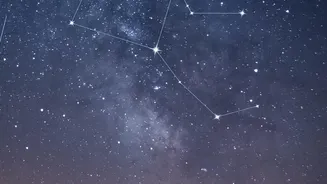
August is one of the best months to witness the core of our own galaxy, the Milky Way. From a dark location, it appears as a faint, glowing band stretching across the sky. The brightest, densest part is located in the direction of the constellations Sagittarius and Scorpius. To find it, look towards the south. Sagittarius is often described as looking like a teapot, and the galactic centre lies just off the tip of its spout. Scorpius is easier to recognise with its hook-like shape. In early August, the Milky Way is visible for most of the night, but by late August, the best time to look is a couple of hours after sunset before it dips below the horizon. A clear night after a rainstorm can provide exceptionally transparent skies, making the view even more breathtaking.
Your Guide to the Summer Constellations
While you're looking for the Milky Way, you can easily spot some of summer's most prominent constellations. High overhead, look for the Summer Triangle, an unmistakable asterism formed by three of the brightest stars in the sky: Vega, Deneb, and Altair. You can spot this trio even from light-polluted urban areas. Vega is the brightest of the three and is nearly directly overhead. As mentioned, Scorpius and Sagittarius are the star attractions in the southern sky. The distinct shape of Scorpius and the 'teapot' of Sagittarius are your signposts to the galactic core. August is also a great time to become familiar with other patterns in the sky, using a stargazing app to help identify the wealth of constellations visible this month.
Essential Tips for Indian Stargazers
The biggest challenge for stargazing in India during August is the monsoon. Cloud cover can obscure the sky for nights on end. Your best bet for clear skies is to head towards regions that receive less rainfall, such as Ladakh, the Spiti Valley, or the Thar Desert in Rajasthan. However, even in other areas, a break in the clouds after a downpour can offer stunning clarity. To make the most of your session, find a spot away from city lights. Give your eyes at least 20-30 minutes to fully adapt to the darkness, and avoid looking at your phone screen. Using a red light torch helps preserve your night vision. You don't need a telescope to start; a pair of binoculars can reveal stunning details, from craters on the Moon to the fuzzy patch of the Andromeda Galaxy.
Finding India's Darkest Skies
If you're serious about seeing the cosmos in all its glory, a trip to a designated dark-sky location is worth the effort. India is now home to its first official Dark Sky Reserve in Hanle, Ladakh. Located at an altitude of 4,500 metres, it offers some of the clearest, darkest skies in the world. Other incredible locations known for their pristine night skies include Spiti Valley in Himachal Pradesh, the Rann of Kutch in Gujarat, Jaisalmer in Rajasthan, and Coorg in Karnataka. These places offer minimal light pollution, allowing the Milky Way and fainter stars to shine brightly, an experience that is impossible from a city.