





A Glimpse into Alien Skies
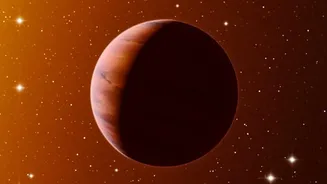
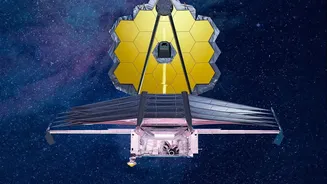
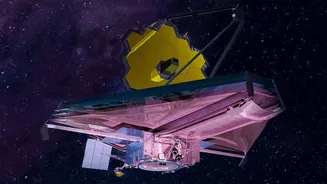
The latest groundbreaking observation comes from the telescope's piercing gaze into the atmosphere of GJ 486 b, a rocky 'super-Earth' located just 26 light-years away. Using its highly sensitive instruments, the James Webb Space Telescope (JWST) identified
the chemical fingerprint of water vapour. This doesn't mean oceans or rain, but rather that molecules of H2O are present in the gaseous envelope surrounding the planet. While other telescopes, including Hubble, have detected water in exoplanet atmospheres before, the clarity and detail provided by JWST mark a monumental step forward in our ability to understand the chemistry of these distant worlds.
How Webb Sees the Unseen
Detecting elements in an atmosphere hundreds of light-years away sounds like science fiction, but it's a technique known as transit spectroscopy. As an exoplanet passes in front of its host star from our perspective, a tiny fraction of the starlight filters through the planet's atmosphere. The gases and molecules in that atmosphere absorb specific colours, or wavelengths, of light. The JWST's Near-Infrared Spectrograph (NIRSpec) is designed to capture this light and spread it into a spectrum—a rainbow of data. By analysing which 'colours' are missing, scientists can determine precisely what molecules are present, creating a chemical inventory of an alien sky. In the case of GJ 486 b, the data revealed a clear absorption pattern that points to water vapour.
The Crucial Quest for Water
In the search for life beyond Earth, the mantra for decades has been "follow the water." Water is essential for every form of life as we know it, so finding it in any form on a distant planet is a profoundly exciting development. However, it is crucial to distinguish between the different states of water. The detection on GJ 486 b is of water vapour in its atmosphere, not liquid water on its surface. This discovery helps scientists understand the building blocks available on other worlds and how planets form and evolve. It suggests that the raw materials for potentially habitable worlds could be common throughout the galaxy.
Not Earth 2.0, But a Vital Clue
Before anyone packs their bags for an interstellar trip, it is important to understand the nature of GJ 486 b. The planet orbits its star at an extremely close distance, completing a full year in just 1.5 Earth days. This proximity results in a scorching surface temperature of around 430 degrees Celsius. At these temperatures, the planet is in no way habitable. Scientists believe that if the planet does have a sustained atmosphere, it is likely being constantly replenished by volcanic activity ejecting steam from the planet's interior. Even so, proving that a hot, rocky world like this can maintain an atmosphere is a huge discovery. It widens the range of planets that astronomers can study and provides a fascinating natural laboratory for understanding planetary geology under extreme conditions.
What This Means for the Future
This detection is more than just a single discovery; it's a powerful demonstration of the JWST's revolutionary capabilities. The telescope is performing beyond expectations, providing data with a precision that was previously unimaginable. Each observation serves as a crucial test case, honing the techniques that will be used to study even more promising targets, including smaller, rocky planets in the habitable zones of their stars—regions where liquid water could potentially exist. Scientists will now work to confirm the origin of the water vapour and search for other molecules. This finding on GJ 486 b is a pivotal stepping stone, bringing us closer to answering one of humanity's oldest and most profound questions: are we alone in the universe?