




An Architecture That Breathes
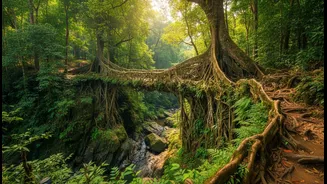
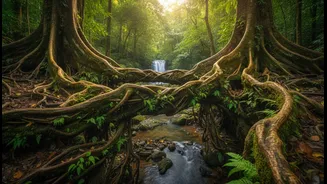
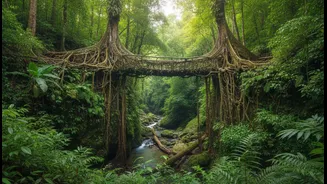
Known as 'Jingkieng Jri' by the local Khasi people, living root bridges are a marvel of bio-engineering. For centuries, the Khasi and Jaintia tribes have guided the aerial roots of the Ficus elastica, or rubber fig tree, across rivers and steep gorges.
The process is a testament to patience. Young, pliable roots are carefully woven and guided, often using hollowed-out bamboo or betel nut trunks as scaffolding. Over 15 to 30 years, these roots reach the opposite bank, anchor themselves, and fuse together through a natural process called inosculation. Unlike concrete and steel structures that decay from the moment they are completed, these living bridges grow stronger, thicker, and more robust with each passing year, some lasting for centuries.
Designed for a Volatile Climate
Northeast India is one of the most vulnerable regions to the impacts of climate change, facing erratic rainfall, devastating floods, and frequent landslides that destroy conventional infrastructure. Concrete and steel bridges can be washed away or rapidly degrade in the region's high-moisture environment, which receives some of the heaviest rainfall on Earth. Living root bridges, however, are perfectly adapted to these extreme conditions. Their complex, intertwined root systems are incredibly resilient, absorbing the shock of flash floods and storm surges. As living organisms, they are self-healing and their continuous growth helps bind the soil, preventing the very erosion that threatens so much of the region's landscape. They are a carbon-negative solution that becomes part of the local ecology, in stark contrast to resource-intensive modern construction.
Passing the Torch to a New Generation
This ancient knowledge is not a relic of the past; it is a critical skill for the future. Community-led initiatives and foundations are now actively working to preserve this tradition by engaging the youth. Organisations like the Living Bridge Foundation, founded by Morningstar Khongthaw, bring elders and young people together for hands-on workshops in the forests. During the monsoon season, the prime time for weaving new roots, young apprentices learn the intricate techniques from the remaining masters of this craft. This transfer of knowledge serves a dual purpose: it preserves an invaluable part of Khasi cultural heritage and equips the next generation with a sustainable method for creating essential rural connectivity. These efforts ensure that the community remains the steward of its own landscape, a model that has gained national attention and a place on UNESCO's tentative World Heritage list.
More Than Just Bridges
The ingenuity of Ficus-based architecture extends beyond crossing rivers. The same principles of root weaving are used to construct a variety of essential rural infrastructure. In the steep hills, communities have grown intricate ladders, sturdy retaining walls to hold back landslides, and even resting platforms suspended from hillsides. This versatility makes it a comprehensive system for building with nature, not against it. By creating infrastructure that is alive, the Khasi and Jaintia communities demonstrate a profound understanding of ecological interdependence. Their work offers a powerful template for sustainable development, showing how indigenous knowledge can provide sophisticated, low-cost, and resilient solutions to some of the most pressing challenges of our time.