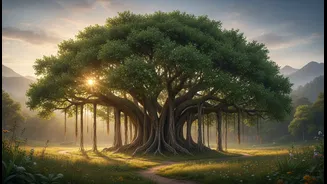









A Witness to Seven Centuries
Deep in Bihar’s Munger district stands a tree that has watched empires rise and fall. For generations, locals knew it was old, but recent scientific analysis has confirmed its staggering age: approximately 700 years. Scientists from the Birbal Sahni Institute
of Palaeosciences used high-precision radiocarbon dating, a method typically reserved for archaeological treasures, to verify its age. This makes it the world's oldest scientifically dated banyan tree. The discovery is significant because banyan trees, a type of tropical broadleaf, don't have the annual growth rings that make dating other trees straightforward. Previously, its age was often linked to a nearby colonial-era building, the Burra Bungalow, which is about 300-350 years old. The research flipped this assumption, revealing the tree was already a centuries-old giant when the bungalow was constructed, a surviving remnant of an ancient forest.
More Than Just a Big Tree
A 700-year-old banyan is not just a botanical wonder; it is a complete ecosystem. Its vast canopy and complex network of aerial roots support a huge variety of life, from birds and insects to other smaller plants, making it a biodiversity hotspot in its own right. Culturally, banyan trees hold a special place in Indian heritage, often serving as natural gathering points for communities, a tradition this tree has likely upheld for centuries. Its sheer resilience and longevity make it a powerful symbol of natural heritage. The scientific confirmation of its age elevates it from a local landmark to a site of global significance, offering a unique draw for those interested in nature, science, and history.
The Vision for a New Tourism
The discovery of the banyan’s true age comes at a time when travellers, both domestic and international, are increasingly seeking authentic and meaningful experiences. This is where the tree’s potential lies. It can be the anchor for a new kind of local tourism—one that is community-led, sustainable, and deeply connected to the local environment and culture. This model moves away from crowded, commercialized tourist traps and focuses on smaller-scale, high-value experiences. It’s about more than just seeing a sight; it's about understanding its context, respecting its environment, and ensuring that the local community benefits directly. Bihar's government has already shown interest in boosting eco-tourism, with plans to develop infrastructure around natural assets like reservoirs and wetlands.
From Roots to Revenue: How It Could Work
A tourism model centred on the ancient banyan would be built around the community. Imagine homestays run by local families, offering guests an authentic taste of Bihari hospitality and cuisine. Local residents could be trained as guides, sharing not just the scientific facts about the tree but also the folklore and personal histories connected to it. This creates jobs and empowers the community, giving them a direct stake in preservation. Furthermore, a small portion of tourism revenue could be directed into a community development fund to improve local infrastructure, such as schools or waste management. This creates a virtuous cycle: tourism funds conservation and community well-being, which in turn enhances the visitor experience. Artisans could sell locally made handicrafts, and farmers could benefit from supplying fresh produce to homestays, spreading the economic benefits throughout the area.
The Path Forward
Realizing this vision requires careful planning. While Bihar has immense tourism potential, studies have noted challenges in infrastructure and policy implementation. For this new model to succeed, it needs support from both the government and the local community. This includes developing responsible tourism guidelines to protect the tree and its surroundings from overuse, providing skill development and training for local entrepreneurs, and improving accessibility to the site without compromising its natural charm. The goal is not to create a mass-market attraction but a niche destination that values quality over quantity. If done right, the 700-year-old banyan of Munger could become a template for how other heritage sites across Bihar and India can be transformed into engines of sustainable and inclusive growth.