


A Tale of Two Planets
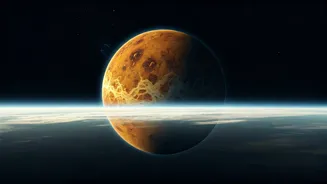
On the surface, the comparison between Earth and Venus seems obvious. They are neighbours in the solar system, and are remarkably similar in size, mass, and rocky composition. It’s believed they formed from the same materials in the same cosmic neighbourhood.
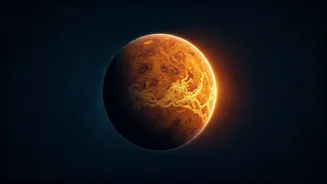
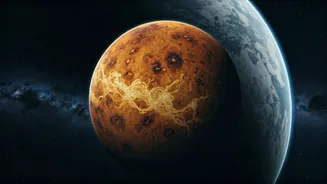
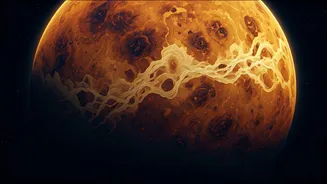
Based on these similarities, one might expect Venus to be a temperate world, perhaps even a second cradle for life. But the reality is brutally different. Venus is the hottest planet in our solar system, with surface temperatures that can melt lead. Its atmosphere is over 90 times denser than Earth's, creating a crushing pressure unimaginable on our world. And instead of life-giving rain, it has clouds of sulfuric acid. This stark divergence is one of the greatest mysteries in planetary science: how did Earth's twin become its 'evil twin'?
The Runaway Greenhouse Mystery
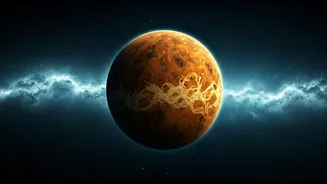
The leading theory for Venus's hostile environment is a phenomenon called the runaway greenhouse effect. Like Earth, Venus has greenhouse gases in its atmosphere, primarily carbon dioxide. These gases trap heat from the Sun. While this process keeps Earth warm enough for life, on Venus it spun out of control. Scientists believe that early in its history, Venus may have had liquid water oceans, much like Earth. But being closer to the sun, the water evaporated, creating a thick blanket of water vapour—a powerful greenhouse gas. This trapped more heat, causing more water to evaporate, in a catastrophic feedback loop. Eventually, the oceans boiled away, and intense solar radiation broke the water molecules apart, allowing the hydrogen to escape into space. This left behind a thick, suffocating atmosphere of carbon dioxide, turning the planet into a permanent furnace. Understanding this process is not just an academic exercise; it serves as a critical cautionary tale for our own planet as we grapple with climate change.
Introducing Shukrayaan-1
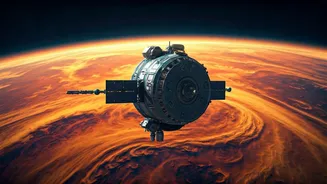
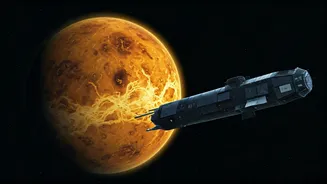
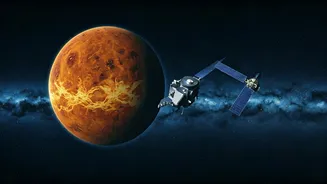
To solve these planetary puzzles, the Indian Space Research Organisation (ISRO) is developing its first-ever mission to Venus: Shukrayaan-1, which translates to 'Venus Craft'. Following its celebrated missions to the Moon and Mars, ISRO is setting its sights on our other nearest neighbour. The government has approved the mission, with a launch planned for 2028. The primary goal of this orbiter mission is to conduct a comprehensive study of Venus from above. It will carry a suite of scientific instruments, some developed in collaboration with international partners, to investigate the planet’s surface and dense atmosphere. The spacecraft will be placed in an elliptical orbit, allowing it to swoop in for close-up observations and pull back for a wider perspective.
What ISRO Hopes to Uncover
The Shukrayaan-1 mission has several key scientific objectives. A primary goal is to map the Venusian surface and shallow subsurface in high resolution. Using a powerful Synthetic Aperture Radar (SAR), the orbiter will be able to peer through the planet's thick cloud cover, something impossible with ordinary cameras. This will help scientists investigate geological features, look for signs of active volcanic hotspots, and understand the processes that shaped its landscape. The mission will also study the composition and dynamics of the mysterious Venusian atmosphere, including its super-rotating winds that circle the planet far faster than the planet itself spins. Another crucial investigation will be how the solar wind interacts directly with Venus's upper atmosphere, as the planet lacks a protective global magnetic field like Earth's.
A Renewed Global Focus on Venus
ISRO's mission is part of a new wave of international interest in Venus after decades of focusing primarily on Mars. NASA is planning two missions, VERITAS and DAVINCI, scheduled to launch around the 2028-2031 timeframe. VERITAS will map the surface in stunning detail, while DAVINCI will bravely plunge a probe through the atmosphere to analyze its chemistry. The European Space Agency (ESA) also has a mission called EnVision planned for the early 2030s, which will study how the planet's core, surface, and atmosphere interact. The combined data from Shukrayaan-1 and these other missions promises a revolutionary new understanding of Venus. This collaborative effort shows that the global scientific community sees the study of Venus as a top priority for understanding how Earth-like planets can evolve.