







The Planet-Sized Data Problem
For decades, satellites have been capturing staggering amounts of information about our planet, accumulating petabytes of data on everything from polar ice caps to urban expansion. By 2024, NASA expected to manage 250,000 terabytes of data from its missions.
This deluge of information holds the keys to understanding climate change, managing natural resources, and protecting vulnerable communities. However, sifting through it to find actionable insights has been a monumental task, often too slow and complex for human analysts alone. The sheer volume of data has historically been a bottleneck, preventing scientists from unlocking its full potential in a timely manner.
Enter Prithvi: An AI for Earth
In response to this challenge, NASA partnered with IBM to develop a new kind of artificial intelligence: a geospatial foundation model. Named 'Prithvi'—the Sanskrit word for Earth—this model is designed to be a flexible, reusable base for a wide range of environmental analyses. Think of it like the large language models that power chatbots, but instead of being trained on text from the internet, Prithvi is trained on vast archives of satellite imagery from NASA's Harmonized Landsat and Sentinel-2 (HLS) dataset. This allows it to learn the fundamental patterns of Earth's systems, from the seasonal cycles of vegetation to the visual signatures of floods and wildfires.
How a Foundation Model Works
A foundation model is pre-trained on a massive, unlabeled dataset using self-supervised learning. In Prithvi's case, it was shown years of global satellite data and learned to identify and understand geospatial patterns on its own. Once this foundational knowledge is established, scientists can then fine-tune the model for specific tasks with much smaller amounts of labeled data. For example, after its initial broad training, Prithvi can be quickly adapted to identify burn scars from a specific wildfire, map the extent of a recent flood, or even track changes in agricultural land use over time. This dramatically cuts down on the time and effort required to build custom AI for each new problem.
Game-Changing Applications for India
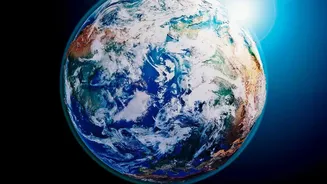
The implications for a country like India are immense. A fine-tuned version of this technology could provide more accurate and timely forecasts for the monsoon, a lifeline for the nation's agriculture. It could be used to monitor the health of Himalayan glaciers, track air and water quality in rapidly growing cities, and provide near-real-time damage assessments after cyclones and floods, enabling faster and more effective disaster response. Another version of the model, Prithvi-Weather-Climate (Prithvi-WxC), focuses specifically on atmospheric dynamics and could improve hurricane tracking and seasonal precipitation forecasting. By making sophisticated analysis more accessible, these tools can empower Indian researchers and government agencies to better manage resources and protect citizens.
The Power of Open Source
Crucially, NASA and IBM have made Prithvi and its associated models open source, available on platforms like Hugging Face. This collaborative, open-science approach is a radical shift. It means that any researcher, startup, or government entity in the world can access, use, and build upon this powerful AI without needing the vast computational resources of a space agency to create it from scratch. This democratizes access to cutting-edge Earth science tools, fostering innovation globally. One research team, for example, surprised NASA by using the model to successfully predict locust breeding grounds in Africa—an application the creators hadn't even envisioned.
The Road Ahead
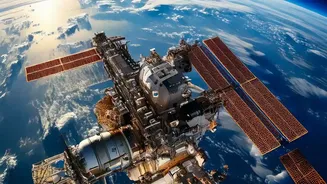
The journey is just beginning. In May 2026, a version of Prithvi became the first geospatial foundation model to be deployed in orbit, running on the International Space Station and another satellite. This demonstrated the potential for onboard AI to analyze data in real-time, delivering insights even faster. However, challenges remain, including the need for significant computing power to fine-tune the models and the importance of ensuring the data is free from biases that could skew results. Despite these hurdles, the path is clear: AI is set to become an indispensable partner in our quest to understand and protect our home planet.