

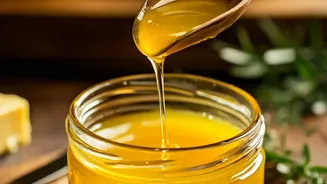


Ghee is a cherished staple in Indian kitchens, but the question of which to use—cow or buffalo—is a common debate. The choice isn't just about taste; it hinges on their distinct fat profiles, which affect everything from health to cooking.
The Visual and Sensory Difference
The first distinction
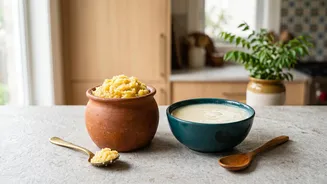
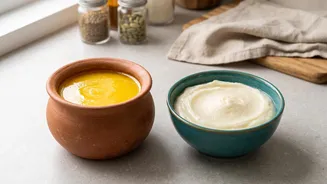
between the two is their appearance. Cow ghee has a characteristic golden-yellow hue, while buffalo ghee is creamy white. This colour difference is not just aesthetic; it's a direct result of their composition. The yellow in cow ghee comes from beta-carotene, a pigment found in the grass cows eat, which their bodies convert into Vitamin A. Buffaloes, on the other hand, fully convert beta-carotene into Vitamin A, so the pigment doesn't get stored in their fat, resulting in a white ghee. This also translates to a difference in taste and aroma. Cow ghee is often described as having a lighter, nutty, and more pleasant flavour, making it a versatile choice for daily cooking. Buffalo ghee has a richer, stronger, and more pronounced flavour and a thicker texture.
A Closer Look at Fat Content
The central difference lies in their fat composition. Both are almost 100% pure fat, but the quantity and structure vary. Buffalo ghee contains a higher fat content than cow ghee. This makes it denser in calories. While cow ghee has around 120 calories per tablespoon, buffalo ghee can have slightly more, making it a preferred option for those looking to gain weight or who have high energy needs, such as athletes. In contrast, cow ghee, being lower in fat and calories, is often recommended for weight management.
Saturated vs. Unsaturated Fats
Both types of ghee are predominantly made of saturated fats. However, their ratios of different fatty acids differ. Buffalo ghee tends to have a slightly higher percentage of saturated fatty acids compared to cow ghee. Conversely, cow ghee often contains a higher amount of polyunsaturated fatty acids (PUFA), which are considered beneficial fats. Some sources also suggest that cow ghee, especially from grass-fed indigenous breeds, is richer in omega-3 fatty acids and conjugated linoleic acid (CLA), which have various health benefits. Because of its lower saturated fat content, cow ghee is sometimes considered a better option for those concerned with heart health, in moderation.
Digestibility and Ayurvedic View
According to both traditional wisdom and consumer experience, cow ghee is considered lighter and easier to digest. This is attributed to its slightly different fatty acid profile. For this reason, cow ghee is frequently recommended for children, the elderly, and those with sensitive digestive systems. In Ayurveda, cow ghee is highly prized and considered a 'satvik' food, believed to promote positivity and clarity. Buffalo ghee is considered heavier and can be harder to digest for some, but is valued for its energy-giving properties, especially during winter to generate body heat.
Vitamins, Minerals and Shelf Life
Both ghees are a source of fat-soluble vitamins like A, D, E, and K. However, cow ghee is particularly rich in Vitamin A due to its beta-carotene content. While buffalo ghee is a good source of minerals like calcium, phosphorus, and magnesium, cow ghee is often cited as containing a wider array of minerals and vitamins overall. One practical advantage of buffalo ghee is its longer shelf life. The higher fat content acts as a natural preservative, allowing it to be stored for longer periods without refrigeration compared to cow ghee.
Best Uses in the Kitchen
The distinct properties of each ghee make them suitable for different culinary applications. With its mild flavour and lower fat density, cow ghee is ideal for everyday cooking, such as for tadkas, spreading on rotis, or mixing into dal and rice. Its smoke point is high, around 230°C, making it great for sautéing. Buffalo ghee, with its richer taste and slightly higher smoke point of around 250°C, excels in the preparation of sweets like ladoos and halwas, as well as for deep-frying. Its creamy texture adds body and richness to dishes.