





A New Shape in the Clouds
Recent images captured by the Hubble Space Telescope have revealed a colossal, 10-sided atmospheric wave churning around Saturn's south pole. This discovery, announced in early September 2026, marks the first time scientists have ever observed a large,
regular polygon in the planet's southern hemisphere. The feature, dubbed a decagon, is not a solid structure but a massive wave within a powerful jet stream, similar to the jet streams that drive weather on Earth. Unlike on our planet, where continents and oceans break up such patterns, the uninterrupted gas of Saturn's atmosphere allows these strange geometric shapes to form and persist. Analysis shows the pattern extends deep into the atmosphere, making it a significant, vertically layered structure, not just a surface-level curiosity.
The Famous Northern Sibling
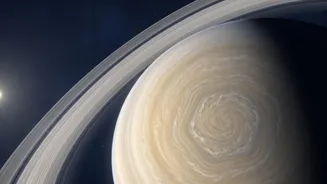
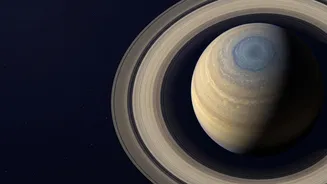
The discovery is particularly exciting because of its famous northern counterpart. For over 40 years, since it was first spotted by the Voyager spacecraft, Saturn's north pole has been home to a remarkably stable six-sided hexagon. This feature, wider than planet Earth, has puzzled scientists for decades, becoming a landmark of the solar system. For a long time, it was considered a unique anomaly. Astronomers had searched for a similar pattern at the south pole for years without success; even NASA's Cassini spacecraft, which orbited Saturn from 2004 to 2017, saw no such long-lived structure there. The sudden emergence of a decagon suggests that the hexagon may not be a one-off freak of nature, but that Saturn's atmosphere has an underlying knack for creating these polygons.
An Evolving Mystery
What makes the southern decagon so compelling is that it appears to be brand new and still evolving. By analysing archival data from Hubble's Outer Planet Atmospheres Legacy (OPAL) program, which annually photographs the outer planets, researchers traced the decagon's origin. Faint hints of the structure began to appear in 2023, becoming progressively more defined through 2024 and 2025. The timing is no coincidence; Saturn's long orbit and axial tilt had kept its south pole largely hidden from Earth-based views from roughly 2012 until 2023. This gives scientists a rare, front-row seat to watch a massive planetary weather system take shape in real-time, an opportunity they never had with the already ancient northern hexagon.
How Do These Shapes Form?
While the exact mechanisms are still being debated, scientists believe these polygons are a type of 'standing wave' in the jet stream. Powerful winds flowing at different speeds and latitudes can create instabilities that, instead of dissipating, lock into a stable geometric pattern that rotates with the planet. Laboratory experiments have shown that rotating fluids can spontaneously form polygons, with the number of sides changing based on the speed and conditions of the flow. The question now facing scientists is why one pole formed a six-sided shape while the other formed a ten-sided one. The difference suggests that the atmospheric dynamics, wind speeds, and pressures are not identical at both poles, and understanding these variations is key to unlocking the secrets of Saturn's weather.