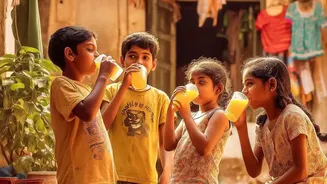







For any household, safe drinking water is a basic necessity. But for families with children and elderly members, it becomes a non-negotiable pillar of health. Their vulnerability to waterborne diseases makes 'pure enough' a risky gamble.
Why Vulnerable Groups Are at Higher Risk
Children and the
elderly are disproportionately affected by contaminated water. A child's immune system is still developing, making them more susceptible to infections from bacteria and viruses commonly found in untreated water, such as those causing diarrhoea, cholera, and typhoid. Diarrhoeal disease is a leading cause of illness and mortality in children under five in India. They also have a higher water intake relative to their body weight, meaning any contaminant dose is effectively larger. For the elderly, a weaker immune system and reduced kidney function make it harder to fight off infections and process impurities. Chronic exposure to contaminants like heavy metals or high levels of dissolved solids can exacerbate existing health conditions. Waterborne diseases like Hepatitis A can also have more severe consequences in these age groups.
Decoding 'Verified' Water Quality in India
The term 'verified' is not just marketing jargon; it refers to water that meets specific standards set by a credible authority. In India, the primary benchmark is the Bureau of Indian Standards (BIS), specifically the IS 10500 standard for drinking water. This standard outlines the acceptable limits for various physical, chemical, and microbiological contaminants. When you see a water purifier with a BIS or ISI mark, it signifies that the product's safety and construction have been certified. However, savvy consumers should look deeper. A genuine certification will be for a specific model and carry a licence number that can be verified on the BIS portal. Vague claims like 'meets BIS norms' without a verifiable number are often a red flag.
Common Contaminants and Your Water Source
The type of contaminants in your water largely depends on your source. Municipal water, while treated, can pick up bacteria, viruses, and sediment from aging pipelines. Groundwater from borewells, on the other hand, is more likely to have high levels of Total Dissolved Solids (TDS)—minerals, salts, and even heavy metals like arsenic and fluoride. The acceptable TDS limit according to BIS is 500 parts per million (ppm), but in the absence of a better source, it can go up to 2000 ppm. However, a low TDS reading does not guarantee safety, as it doesn't measure microbial contamination. Therefore, the first step for any family should be to understand their water, either through a home TDS meter or professional lab testing.
Choosing the Right Purification Technology
Understanding your water quality is key to selecting the right purifier technology. The three main types are RO, UV, and UF. Reverse Osmosis (RO) is the only technology that effectively removes dissolved solids, heavy metals, and chemicals, making it essential for water with high TDS (generally above 300-500 ppm). Ultraviolet (UV) purification uses a lamp to neutralise bacteria and viruses but does not remove dissolved solids or chemicals. It is suitable for water with low TDS but suspected microbial contamination. Ultrafiltration (UF) uses a membrane to physically block bacteria and larger particles but cannot remove dissolved solids or very small viruses. For most Indian households, especially those with fluctuating water quality or high TDS, a combination purifier (RO+UV) offers the most comprehensive protection.
Beyond the Purifier: A Checklist for Families
Ensuring water safety is an ongoing process. Once you've chosen a certified purifier suited to your water type, regular maintenance is critical. Filters and membranes need to be changed according to the manufacturer's schedule to remain effective. An RO membrane might last 2-3 years, while sediment filters need changing every 6-12 months and UV lamps annually. It's also wise to check the TDS of your purified water periodically. An ideal range for health and taste is often cited as 50-150 ppm, as overly purified water can be stripped of essential minerals. Finally, always use purified water for preparing infant formula, and ensure it is boiled and cooled first. Storing water in clean, covered containers is another simple but crucial step to prevent re-contamination.