


What is the SunRISE Mission?
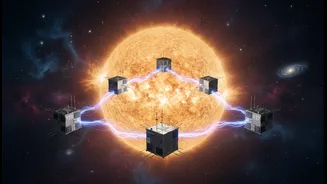
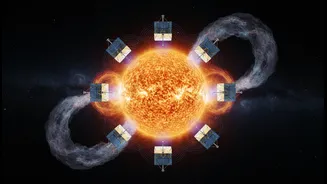
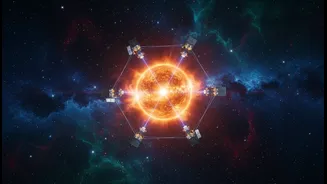
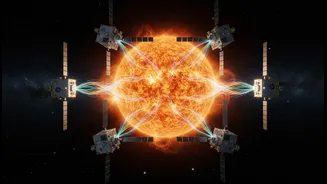
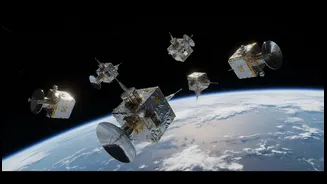
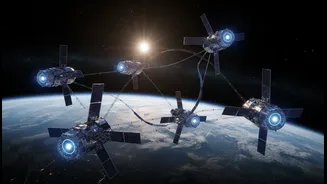
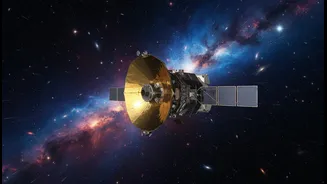
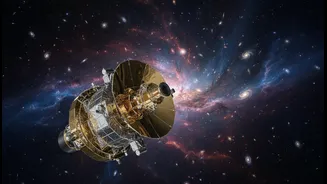
SunRISE, which stands for the Sun Radio Interferometer Space Experiment, is a pioneering NASA mission designed to unlock the secrets of our star. It consists of a constellation of six identical small satellites, each about the size of a toaster oven or a cereal
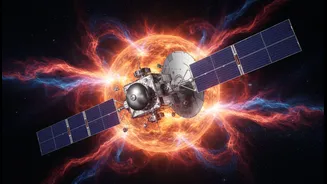
box. These spacecraft have completed assembly and testing and are awaiting their launch into space. The latest news, as of July 2026, is that the mission will be launched into orbit aboard a SpaceX Falcon Heavy rocket. This mission is not about taking pretty pictures in visible light; instead, it's tuned to listen. SunRISE is designed to detect and map low-frequency radio waves that are generated during massive solar eruptions, which are often precursors to dangerous solar particle storms.
A Virtual Telescope 10 Kilometres Wide
The most ingenious part of the SunRISE mission is how these six small satellites, or CubeSats, will work together. They will fly in a loose formation about 35,000 kilometres above the Earth, spread out over an area roughly 10 kilometres (or 6 miles) wide. This specific orbit is crucial because Earth's own atmosphere blocks the very low-frequency radio signals the mission needs to study. Using a technique called interferometry, data from all six individual spacecraft will be combined back on the ground. This process effectively turns the small constellation into a single, massive virtual radio telescope with an aperture as wide as the distance between the satellites. Building a single 10-kilometre-wide structure in space is not yet possible, so this innovative swarm approach allows scientists to achieve the same powerful result with existing technology.
Why Satellite Operators Should Care
The SunRISE mission is of critical importance to anyone who operates or relies on satellites. The primary scientific goal is to better understand space weather, particularly coronal mass ejections (CMEs). These are violent eruptions from the sun's atmosphere that hurl enormous clouds of charged particles into space. When these solar particle storms hit Earth, they can cause serious damage to the electronics of orbiting satellites, disrupt GPS and communication signals, and even pose a radiation hazard to astronauts. Scientists have noticed that major radiation events are often preceded by a bright burst of radio waves. By creating 3D maps of where these radio bursts originate, SunRISE will help scientists understand the mechanisms that accelerate these dangerous particles. This could provide an early warning system, giving satellite operators and mission planners crucial time to take protective measures before a storm arrives.
An Inspiration for Students and Future Scientists
Beyond its immediate scientific goals, the SunRISE mission is a powerful example of the future of space exploration. It demonstrates how clever engineering and the use of smaller, cost-effective CubeSats can be used to answer some of the biggest questions in science. The mission is led by the University of Michigan and managed by NASA's Jet Propulsion Laboratory, involving collaboration across universities and industry. This cooperative model provides an inspiring case study for students interested in science, technology, engineering, and mathematics (STEM). The mission's use of a swarm of robots working together is a cutting-edge concept that will likely become more common in future space missions. For students looking toward the future of space, SunRISE isn't just a mission to watch; it's a blueprint for how they might one day explore the cosmos themselves.