


Why Your Desk Job Demands a Specific Workout
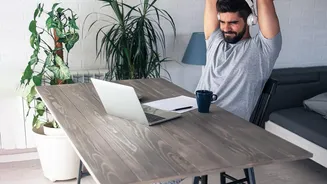
Spending eight or more hours a day in a chair creates a predictable pattern of muscular imbalance. Your hip flexors and chest muscles become tight from being in a shortened position, while your glutes and upper back muscles become weak and underactive.
This combination often leads to rounded shoulders, an arched lower back, persistent pain, and a general feeling of stiffness. A generic workout might miss these specific issues. The goal is not just to burn calories, but to actively reverse the postural damage caused by a sedentary lifestyle by strengthening the muscles that sitting weakens and stretching the ones it tightens.
The Workout Philosophy: Efficiency and Function
For a busy professional, time is everything. This plan is built on efficiency, focusing on compound exercises that work multiple muscle groups at once. You'll primarily target the posterior chain—the muscles on the back side of your body, including the glutes, hamstrings, and back muscles—which are crucial for good posture and are often neglected during long periods of sitting. We recommend a full-body strength routine performed two to three times per week. This frequency allows for adequate muscle recovery while still delivering consistent results. Alternate between Workout A and Workout B on non-consecutive days to ensure a balanced approach.
Essential Dynamic Warm-Up (5-10 Minutes)
Never skip your warm-up. The goal is to increase blood flow and improve mobility in the joints that get stiff from sitting. Perform each movement for 30-60 seconds. Start with light cardio like jogging in place or jumping jacks. Follow this with arm circles to open up the shoulders and leg swings (forward-and-back and side-to-side) to mobilise the hips. Finish with 'Cat-Cow' stretches on all fours to gently move the spine and thoracic rotations to improve upper-back mobility.
Workout A: Posterior Chain Power
This workout focuses on building strength in your glutes, hamstrings, and back. Perform 3 sets of 8–12 repetitions for each exercise. Focus on controlled movements and proper form. 1. Romanian Deadlifts: This is a top–tier exercise for strengthening the hamstrings and glutes. It directly counteracts the effects of weak posterior muscles from sitting. 2. Bent–Over Rows: This movement targets the muscles of the upper back, helping to pull your shoulders back and correct a slouched posture. 3. Goblet Squats: Squats help to open up tight hips and strengthen the entire lower body and core. Holding the weight in front engages your core to keep your torso upright. 4. Plank: A foundational core exercise, the plank builds endurance in your abdominal and lower back muscles, which is vital for maintaining good posture throughout the workday. 5. Face Pulls: An excellent accessory move to combat rounded shoulders. Use a cable machine or a resistance band to pull the rope towards your face, focusing on squeezing your shoulder blades together.
Workout B: Full Body Strength and Stability
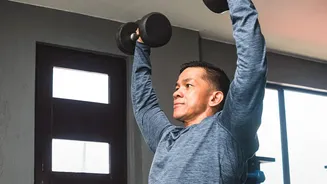
Alternate this routine with Workout A. Again, aim for 3 sets of 8–12 repetitions unless otherwise specified. This workout introduces different movement patterns to ensure balanced development. 1. Barbell or Dumbbell Squats: The squat is a fundamental movement for overall strength. It strengthens your quads, glutes, and core, all of which support a healthy posture. 2. Dumbbell Shoulder Press: Sitting often leads to weak, internally rotated shoulders. Pressing weight overhead helps build shoulder strength and stability. 3. Single–Leg Glute Bridges: This exercise isolates the glutes, helping to 'wake up' muscles that become dormant from sitting. Perform 12–15 reps per side. 4. Lat Pulldowns: This machine exercise strengthens your latissimus dorsi, the large muscles in your back that contribute to a wider, stronger frame and better posture. 5. Dead Bug: Lie on your back and slowly lower your opposite arm and leg. This is a fantastic core stability exercise that protects your lower back.
Crucial Cool–Down and Stretching (5–10 Minutes)
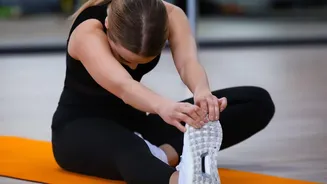
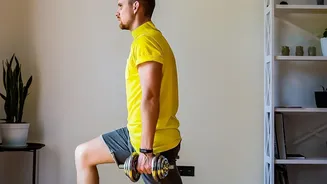
After your workout, dedicate time to stretching the muscles that are chronically tight from sitting. Hold each stretch for $20–$30 seconds without bouncing.$ Key stretches include a hip flexor lunge to open the front of your hips, a seated figure–four stretch for your glutes and piriformis, and a doorway chest stretch to counteract rounded shoulders.$ A simple forward bend can also help relieve tension in the hamstrings and lower back.