



Sailing on Sunshine
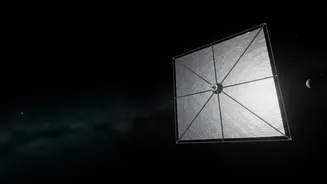
The concept of a solar sail sounds like science fiction, but it’s grounded in real physics. Light, though it has no mass, is made of particles called photons that carry momentum. When these photons strike a reflective surface, they transfer their momentum,
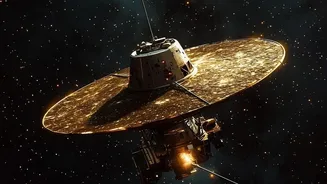
giving the surface a tiny push. In the vacuum of space, where there is no friction, this continuous push, however slight, can build up over time to propel a spacecraft to incredible speeds. Unlike rockets that burn through heavy fuel in a short burst, a solar sail provides constant, gentle acceleration for as long as it is exposed to sunlight. This method is not powered by solar wind, which is a stream of charged particles from the sun, but by the pressure from light itself. By angling the sail, a spacecraft can even steer, tacking across the solar system much like a sailboat on water.
The Weight and Heat Problem
While the theory has been understood for decades, practical application has been held back by significant challenges. Early solar sails, often made of materials like Mylar or polyimide coated with aluminum, proved the concept but had limitations. To be effective, a sail must be enormous—the size of a boxing ring or even a basketball court—yet incredibly lightweight. If the sail is too heavy, the gentle push from photons won't be enough to accelerate it meaningfully. Furthermore, as a spacecraft gets closer to the sun to perform a gravity-assist maneuver, the intense heat can damage or distort traditional sail materials, compromising the mission. For solar sailing to move from niche experiments to a primary mode of propulsion, it needed a new generation of materials that were both lighter and more resilient.
A Material Revolution
Recent breakthroughs in materials science are now solving these problems. NASA's Advanced Composite Solar Sail System (ACS3) mission is a prime example, demonstrating booms made from a flexible polymer reinforced with carbon fiber. These composite booms are 75% lighter and far more resistant to thermal distortion than previous metallic versions. Researchers are also developing sails made from new photonic materials and nanoengineered structures. One promising concept involves a multi-layered material that is mostly empty space, designed to be highly reflective at a specific wavelength of light while allowing most other solar radiation to pass right through. This drastically reduces heating and brings the weight down to just a few grams per square meter. These innovations are making sails stronger, lighter, and more controllable than ever before.
From Theory to Deep Space Missions
This new technology is already being put to the test. Following the success of earlier missions like Japan's IKAROS and The Planetary Society's LightSail 2, which successfully used sunlight to change its orbit, NASA is pushing the technology further. The ACS3 system, launched in 2024, is testing the deployment of its advanced composite booms in low-Earth orbit. Looking ahead, NASA and NOAA are partnering on designs for massive sails, some covering an area equivalent to four basketball courts, to position space weather satellites closer to the sun for earlier storm warnings. These demonstration missions are crucial for validating the technology for more ambitious deep-space applications, such as asteroid reconnaissance or missions to the solar poles, which are difficult to reach with conventional rockets.
Unlocking the Outer Solar System and Beyond
The true promise of advanced solar sails is the way they could revolutionize deep-space exploration. By eliminating the need for heavy propellant, missions become significantly cheaper and can carry more scientific instruments. The continuous acceleration allows spacecraft to reach speeds far greater than chemical rockets over time. Missions that currently take many years, like the journey to Jupiter, could potentially be completed in a fraction of the time. Some concepts even propose using an initial 'slingshot' maneuver close to the sun to achieve extreme velocities, enabling rapid transit to the outer planets or even sending probes on the long journey to other stars. With these ultra-light materials, solar sailing is evolving from a novel idea into a key enabling technology for the next era of cosmic exploration.