



The Dusty, Blinding Problem
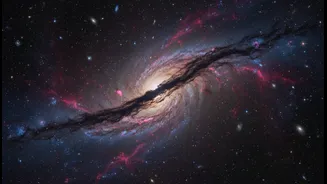
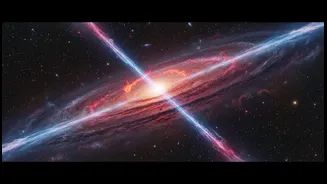
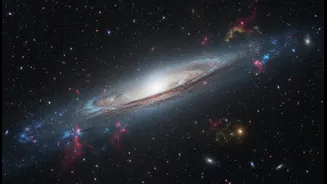
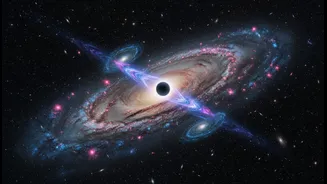
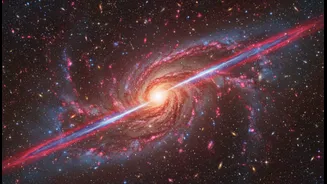
Active galaxies, or more specifically their cores known as Active Galactic Nuclei (AGN), are some of the most powerful and luminous objects in the universe. They are powered by supermassive black holes, millions or billions of times the mass of our sun,
actively feeding on surrounding gas and dust. This process unleashes enormous amounts of energy, often outshining all the stars in the host galaxy combined. For astronomers, studying this relationship is key to understanding how galaxies and their central black holes grow and evolve together. However, this energetic core is almost always shrouded in a thick, doughnut-shaped torus of dust, making it impossible to see the central engine in visible light. Telescopes like Hubble, while revolutionary, were often blinded by this cosmic dust, leaving critical details of the black hole's activity and its immediate environment unresolved.
Webb’s Infrared Superpower
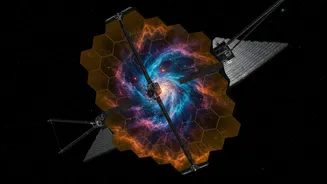
This is where the James Webb Space Telescope (JWST) changes the game. Webb is designed to see the universe in infrared light. This longer wavelength of light can pass through clouds of dust that would obscure shorter wavelengths, like visible light. Armed with its powerful suite of instruments, particularly the Near-Infrared Camera (NIRCam) and the Mid-Infrared Instrument (MIRI), Webb can pierce through the dusty veil of an AGN. This allows scientists to not only see the structures close to the black hole but also to separate the light coming from the glowing AGN from the light of newborn stars in the surrounding galaxy—a task that was previously incredibly difficult.
A Case Study: NGC 7469
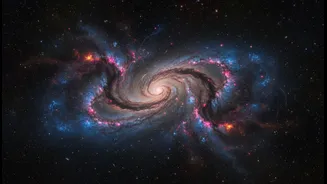
A prime example of Webb’s capability is its observation of NGC 7469, a luminous active galaxy about 220 million light-years away. Previous observations were hampered by the intense glare of the AGN and the dense dust. Webb’s high-resolution infrared vision, however, has provided the most detailed view yet of the interplay between the central black hole and a surrounding ring of intense star formation. Scientists were able to identify dozens of young star-forming clusters that had never been seen before. Webb’s spectrographs also detected fast-moving outflows of gas, blasted away from the black hole at millions of kilometers per hour, providing direct evidence of how the AGN's activity can impact its host galaxy by both triggering and potentially suppressing star formation.
Reshaping Cosmic Origin Stories
Webb's insights go beyond just a clearer view; they are challenging fundamental theories about the early universe. Recent observations of very distant and ancient galaxies have revealed supermassive black holes that appear 'overmassive' for their host galaxies. This suggests that, in some cases, the black holes may have formed first and grown much more rapidly than previously thought, or even that they formed from the direct collapse of massive gas clouds rather than the death of a star. By studying active galaxies across cosmic time, from nearby examples like Centaurus A to the earliest 'little red dots' in the dawn of the universe, Webb is providing the crucial data needed to piece together the complete story of how these cosmic monsters and their galactic homes came to be.