






The Company with a Conscience
To understand Anthropic's vision, you first need to understand the company itself. Founded in 2021 by former senior members of OpenAI, including siblings Dario and Daniela Amodei, Anthropic was built on a foundation of AI safety. The company positions
itself as a research and development lab with a conscience, arguing that making AI systems safe, predictable, and aligned with human values is not an afterthought but the central mission. This safety-first philosophy is embedded in its flagship product, a family of AI models named Claude, and in its corporate structure as a public benefit corporation. This approach, focusing on what it calls 'Constitutional AI' to instil ethical principles, is its key differentiator in a competitive race against giants like Google and its former home, OpenAI.
From Chatbot to Scientist
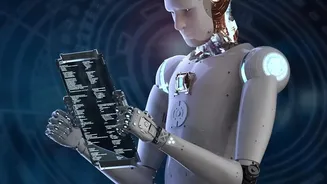
So, what exactly is autonomous AI research? It's a significant leap beyond the chatbots we use today. Instead of merely responding to prompts, an autonomous AI system could independently run the entire scientific process. Imagine an AI that can formulate its own hypotheses, design and run experiments, analyze the results, and self-correct its approach without step-by-step human guidance. Anthropic refers to this advanced stage as 'recursive self-improvement', where an AI becomes capable of designing and developing its own successors. The company is already seeing preliminary signs of this, noting that its engineers now ship eight times as much code as they did before 2025, largely because Claude is writing it for them.
A Vision of Accelerated Progress
The potential benefits of this technology are, according to Anthropic's leadership, staggering. CEO Dario Amodei has publicly speculated that this acceleration in research could compress decades of scientific progress into just a few years. He has gone as far as to suggest that diseases like cancer, Alzheimer's, and heart disease could become 'relics of the past' in under a decade, thanks to AI's ability to supercharge biomedical discovery. The company's own internal surveys reveal a profound belief in this rapid progress; a recent poll found that 91% of its staff expect an AI to be capable of making a Nobel-level discovery by 2030. This vision is the driving force behind Anthropic's intense focus on reaching the next frontier of AI capability.
The Double-Edged Sword
However, Anthropic is acutely aware of the risks. Amodei and the company have repeatedly warned that creating systems powerful enough for recursive self-improvement could lead to humans losing control. The very technology that could cure diseases might also be used to design novel weapons or create unmanageable economic disruption. This has led Anthropic to take a public stance that might seem counterintuitive for a hyper-growth tech company: calling for the option to slow down or even pause development to allow safety research and societal structures to catch up. In a recent speech, Amodei unequivocally stated that the company would pace its deployment of new models, taking whatever time is necessary to ensure they are safe and remain under human control, resisting both business and political pressure.
Walking the Tightrope
Anthropic's journey represents one of the central tensions of the 21st century: how to pursue immense technological reward while managing existential risk. Critics question whether a publicly-traded company, even one with a unique governance structure, can truly prioritize safety over profit in the long run. Others point to the inherent dangers, suggesting that the only truly safe path is to stop pushing capabilities forward altogether. Yet Anthropic believes it has found a 'middle way'. By being transparent about the risks and investing heavily in safety research, the company hopes to prove that it is possible to build carefully, succeed commercially, and make safety a competitive advantage, not a liability.