







Your Essential Stargazing Toolkit
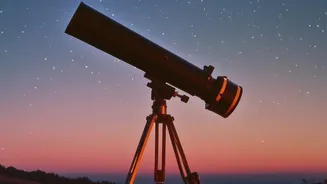
Getting started is simpler than you think. First, find the darkest spot you can, away from direct streetlights or building lights—even a balcony or a quiet park will do. Give your eyes about 20 minutes to adjust to the darkness; this is crucial for spotting
fainter objects. Second, patience is your best friend. Planets don't twinkle as intensely as stars; they shine with a steadier light, which is your primary clue for telling them apart. Finally, technology can be a great guide. Apps like Stellarium or SkyView can turn your phone into a live sky map. Just point it at the sky, and it will identify the planets, stars, and constellations for you. Many are free and work well even in urban settings.
The Evening Star: Saturn
Saturn is the main event in the evening sky this month. Although its spectacular opposition was in early October, it remains bright and easily visible throughout November. Look towards the south after sunset. It will appear as a bright, steady, golden-hued point of light. While its famous rings are only visible through a telescope, spotting the planet itself with your naked eye is a rewarding experience. Saturn will be visible for most of the night, slowly tracking across the sky towards the west before it sets in the early morning.
The Morning Show: Jupiter and Mars
If you're an early riser, the pre-dawn sky has a spectacular pairing in store for you. Look to the eastern sky before sunrise to spot two bright planets: Jupiter and Mars. Jupiter is unmissable—it will be brilliantly bright, outshining every star in the sky. The much fainter, reddish dot of Mars will be nearby. Around November 15th and 16th, the two planets will appear very close together, creating a beautiful celestial conjunction that's perfect for naked-eye viewing or even capturing with a smartphone camera on a tripod. Mars will be brightening throughout the month as it heads towards its own opposition in February 2027.
The Dazzling Return of Venus
After a stint as an 'evening star', Venus returns to the morning sky in November, and it does so in style. Starting from early November, you can spot it low on the eastern horizon just before sunrise. By the middle of the month, it will be much easier to see as it climbs higher. Towards the end of November, around the 25th, Venus will reach its greatest brightness for the year, shining as a dazzlingly bright point of light that is impossible to miss.
Spotting From Your City
Whether you are in Delhi, Mumbai, Bengaluru, or Kolkata, the directions remain largely the same. The key is your horizon. Saturn will be visible in the evening towards the south, Jupiter and Mars in the pre-dawn east, and Venus will join them there as the month progresses. In major cities, light pollution can be a challenge. The best strategy is to get as high up as possible—a rooftop or a high-floor balcony can make a significant difference. Give yourself an unobstructed view, especially towards the east for the morning planets. Remember that planets rise in the east and set in the west, just like the Sun and Moon. For specific rise and set times for your exact location, a quick check on a stargazing app is your best bet.
Special Mention: The Ice Giants
For those with a bit more patience and at least a pair of binoculars, two other planets are technically visible. Uranus reaches opposition on November 25, meaning it is at its brightest for the year. Neptune is also lingering in the evening sky. Both will look like faint, star-like points. Identifying them without a star chart or app is very difficult for a beginner, but knowing they are part of the planetary parade adds another layer of wonder to your skywatching session. Don't worry if you can't spot them; focus on the bright, easy targets first.